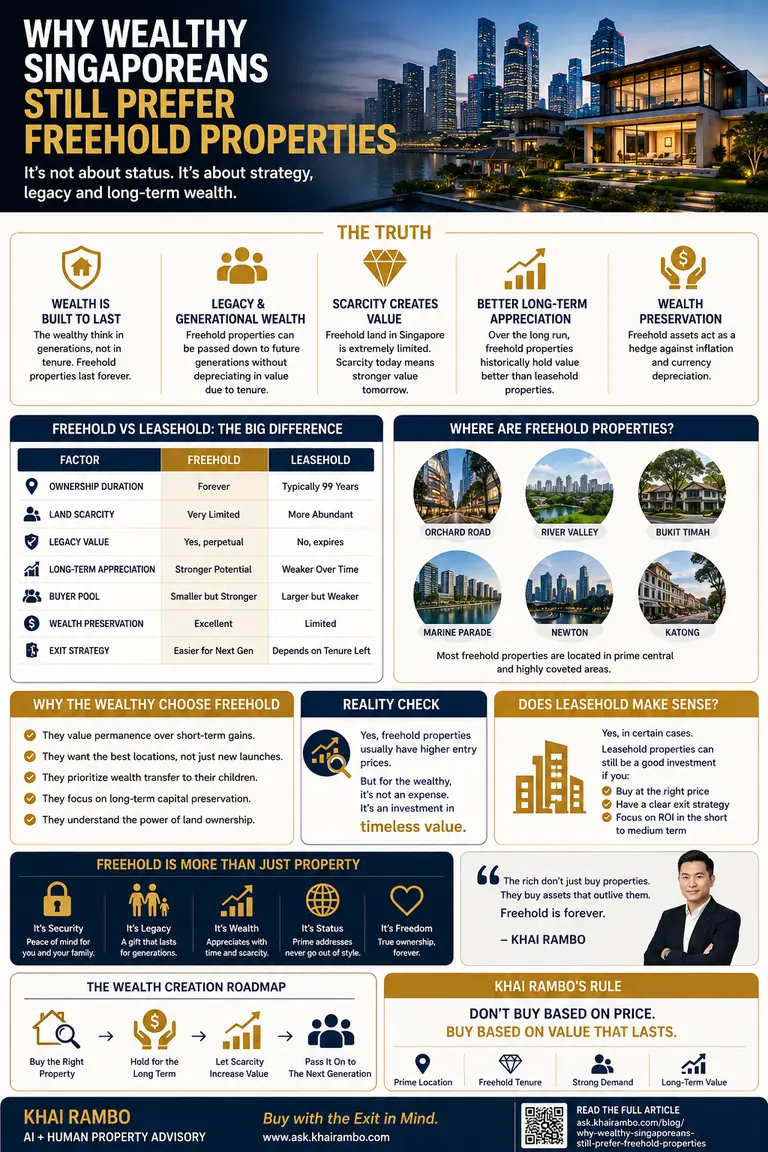
Freehold status remains a top preference for many wealthy Singaporeans, even as leasehold launches dominate the market. This article explains the reasons behind that preference, the financial logic, and why freehold still matters for long-term portfolio building.
1. The value of ownership that never expires
Freehold ownership has no fixed lease expiry, so affluent buyers often see it as a durable store of family capital rather than merely a home. Perpetual tenure removes one source of long-term uncertainty, although the property’s condition, location, entry price and future demand still determine whether ownership preserves value.
Wealthy buyers often view freehold as the closest thing to true ownership in Singapore. Unlike 99-year leasehold, freehold units do not have a clock ticking down on land tenure, and that gives buyers a lasting sense of security.
2. Legacy and inter-generational planning
Freehold property can support intergenerational planning because heirs receive an asset without a shortening land lease. Families may find its long horizon easier to hold, explain and allocate within an estate. Transfer taxes, maintenance, family needs and ownership structure still require professional planning; tenure alone does not make succession simple.
For high-net-worth families, property is often more than a home—it is a legacy asset. Freehold properties are easier to pass down, and they avoid the mental friction of explaining a diminishing lease to the next generation.
- Gives families confidence that the asset retains heritage value
- Reduces the complexity of long-term estate planning
- Supports a portfolio mix that includes both income and capital preservation assets
3. Resale premium and perception
Freehold homes can attract stronger buyer perception and a resale premium because purchasers value perpetual tenure and the absence of lease decay. That premium is not guaranteed to grow or be recovered. Investors should compare nearby leasehold transactions, project quality, age and buyer demand before paying extra for tenure.
Freehold properties often command a premium in the secondary market because buyers perceive them as more desirable. Investors and affluent owners are willing to pay extra for an asset with no lease decay risk.
4. Freehold still wins in prime locations
In prime locations, freehold tenure adds scarcity to land that is already difficult to replace, strengthening its appeal to affluent buyers seeking established addresses. The combination can support resale positioning, but a prestigious district does not excuse overpayment. Accessibility, development quality, plot attributes and competing supply remain essential.
When wealthy buyers target prime districts, a freehold title adds a layer of scarcity. This is especially true for projects in Bukit Timah, Orchard, East Coast and the city fringe where land is already tight.
5. The numbers behind the preference
The financial preference for freehold reflects a trade-off: buyers usually pay a higher entry quantum for perceived capital resilience, estate-planning simplicity and resale appeal. Leasehold homes may offer better affordability or rental yield. Compare the actual premium, holding period, rental demand, maintenance and likely exit price rather than tenure labels alone.
In many cases, the freehold premium is balanced by better capital resilience. Here is how the most common comparisons play out:
Evidence note: The table records buyer hypotheses and professional observations, not measured market statistics. Test every point against like-for-like records in URA's official private residential transaction service.
| Comparison | Freehold | 99-Year Leasehold | Reason |
|---|---|---|---|
| Pricing | Usually higher quantum | More affordable entry | Freehold is often valued for longevity. |
| Capital preservation | No universal advantage; compare like for like | More lease decay risk | Freehold is perceived as safer heritage capital. |
| Rental profile | Project- and location-specific | Project- and location-specific | Tenure alone does not establish tenant demand. |
| Estate planning | No fixed lease expiry, but legal planning still required | Requires more planning for lease decay | Freehold accumulates legacy value. |
| Resale demand | Transaction-specific willingness to pay | Transaction-specific buyer demand | Measure the actual premium and liquidity. |
6. Which freehold locations wealthy buyers favour
Affluent buyers often favour established freehold enclaves in Bukit Timah, Orchard, the East Coast and selected city-fringe or CBD-adjacent clusters. These locations combine scarce tenure with transport, amenities and address recognition. The strongest choice is not a district name alone, but a specific project with durable demand and sensible pricing.
Wealthy Singaporeans tend to concentrate on these freehold niches:
- City-fringe freehold condos with strong transport access
- Low-rise estates in Bukit Timah and Bukit Timah Road
- Premium mid-tier freehold launches in the East Coast area
- Rare boutique freehold clusters near the CBD
7. Why freehold still matters despite a strong leasehold market
Freehold still matters in a strong leasehold market because affluent buyers may prioritise legacy, perpetual tenure and capital preservation over a lower entry price. Leasehold projects can nevertheless outperform through superior location, newer facilities or stronger rental demand. The relevant question is whether the freehold premium improves the buyer’s actual long-term outcome.
Leasehold developments continue to offer value, but wealthy buyers make decisions differently. For them, the choice is about family capital, market resilience and the perception that freehold is the superior long-term asset.
- They can afford the premium and treat it as insurance.
- They know freehold is easier to explain and justify to heirs.
- They appreciate that freehold addresses often have stronger brand recall.
8. Practical advice for investors and upgraders
Investors and upgraders should calculate the freehold premium against comparable leasehold homes, then test whether location, project quality, rental demand and likely resale appeal justify it. Include financing, maintenance and renovation in the comparison. Buy freehold for a defensible property-level advantage, not because perpetual tenure automatically guarantees stronger returns.
If you are considering freehold, focus on the following:
- Compare nearby leasehold alternatives and calculate the freehold premium.
- Choose a location with both current demand and long-term relevance.
- Remember the total cost of ownership, including maintenance and potential future value.
- Speak to an advisor who understands the trade-off between freehold premium and actual wealth outcomes.
9. The final takeaway
Some affluent Singapore buyers prefer freehold property for tenure certainty, legacy planning and perceived resale positioning. That preference does not prove superior returns or justify every premium. The decision remains property-specific: compare location, entry price, land share, upkeep, rent and like-for-like transactions before treating perpetual tenure as the better investment.
That does not mean freehold is always the right choice for every buyer. But if your priority is long-term capital and inter-generational property stewardship, freehold is the reason many wealthy families still choose it.
Frequently Asked Questions
Why do affluent buyers prefer freehold property?
Some affluent buyers prefer freehold property because the tenure does not run down, which can support long holding periods, legacy planning and perceptions of scarcity. They may also value established freehold locations and land attributes. These benefits remain property-specific, and a buyer should still compare the premium with location quality, income potential and future demand.
Is freehold property always better for legacy planning?
Freehold tenure can simplify a very long holding objective, but it is not automatically the best legacy asset. Maintenance, taxes, ownership structure, liquidity, beneficiary needs and the property's quality still matter. Families should compare a specific freehold home with diversified alternatives and obtain relevant legal or estate-planning advice instead of relying on tenure alone.
Can a leasehold property outperform a freehold property?
Yes, a well-located leasehold property bought at a sensible price can outperform a more expensive freehold alternative over a given holding period. Transport, amenities, project quality, rent, supply and the initial tenure premium all matter. Compare like-for-like transactions and net returns rather than assuming the title alone determines investment performance.
Which official sources should you verify?
Property rules, financing limits, duties and market figures can change after publication. Before acting, verify the claim that affects your decision with the responsible Singapore institution below. The article’s comparisons and professional observations are general guidance; your current eligibility, loan assessment, tax position and transaction documents remain decisive.
- MoneySense Singapore property guidance
- Inland Revenue Authority of Singapore (IRAS) property guidance
- Urban Redevelopment Authority (URA) property guidance
- Council for Estate Agencies (CEA) property guidance
Source review: Primary-source links checked 17 July 2026. See the property editorial and correction policy for the evidence standard.
Want a private review of freehold vs leasehold for your portfolio?
I’ll help you assess whether freehold makes sense for your wealth goals and property strategy.
WhatsApp Khai Rambo Get Free Valuation