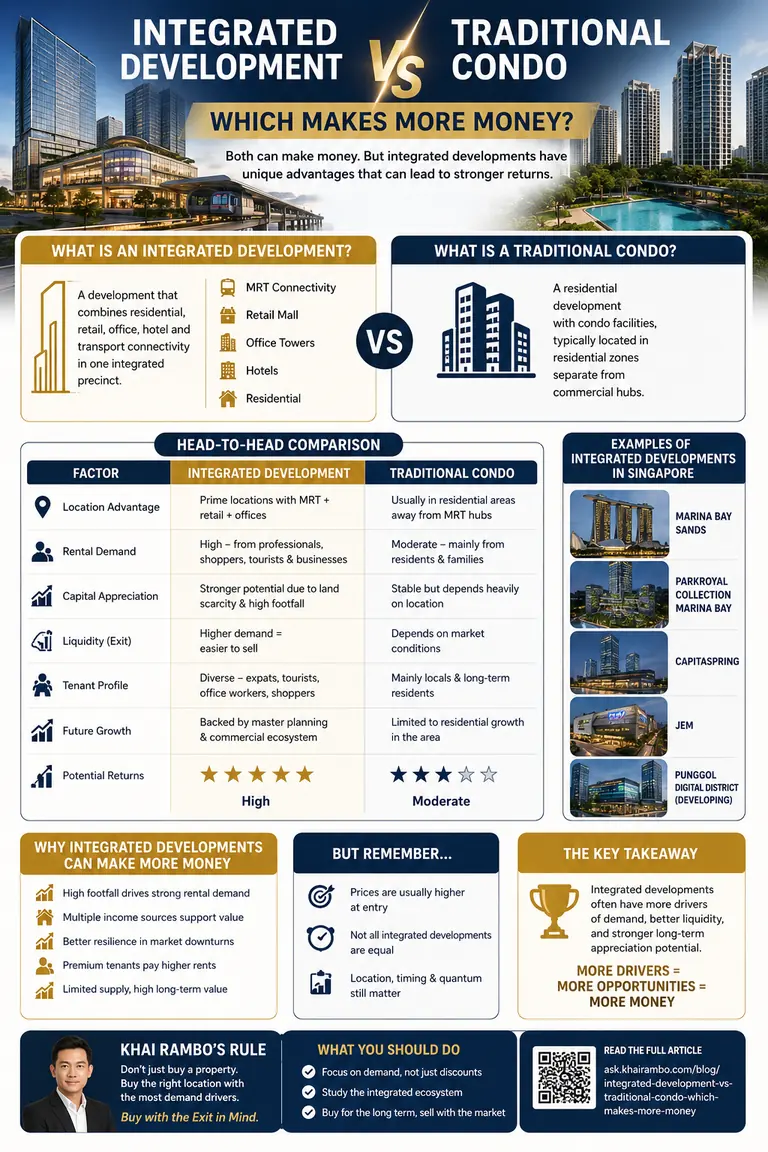
Integrated developments and traditional condos each have their own investment appeals. This article compares the numbers, the rental demand, the exit profile and the cash-flow story for Singapore buyers who want to know which structure can make more money.
1. What is an integrated development?
An integrated development combines private homes with one or more connected uses such as a mall, food outlets, offices, a hotel or public transport. Its investment appeal comes from convenience and built-in footfall, but buyers must still evaluate residential privacy, maintenance costs, entry price and dependence on the commercial component.
Integrated developments combine private residential units with retail, F&B, hotels, transport or business space in one project. They usually offer:
- Direct access to MRT stations or mall lifestyles
- Stronger footfall for renters and buyers
- Potentially higher premiums for convenience
- More structural rent support in good locations
2. What is a traditional condo?
A traditional condo is a predominantly residential project with shared facilities, landscaping and controlled access but no fully integrated mall or transport interchange. Its value proposition is quieter living, privacy and a clearer residential identity, while performance depends on location, project quality, unit mix, management and the strength of nearby rather than on-site amenities.
Traditional condos are standalone residential developments that focus on living amenities, privacy and landscaping. Their appeal is usually driven by:
- Large pool decks, clubhouses and green space
- Lower common property premiums than mall-based projects
- Stronger appeal to families and downsizers
- Typically lower maintenance costs compared to integrated projects with mall components
3. Why compare them?
Investors should compare integrated and traditional condos because convenience premiums do not automatically produce superior total returns. Purchase price, rent, vacancy, maintenance, resale liquidity and future supply can favour either format. A like-for-like comparison in the same neighbourhood reveals whether integration adds enough demand to justify its price premium.
For investors, the question is not just “which is newer?” but “which structure delivers higher total returns?” The answer depends on:
- Price quantum and entry position
- Rental demand and tenant profile
- Sales pool and resale upside
- Financing, holding costs and future supply
4. Comparison table: integrated development vs traditional condo
As a qualitative framework, integrated developments lead on direct transport and retail convenience, while traditional condos may offer more privacy, landscaping and a calmer owner-occupier experience. Neither format has a proven universal lease-up or return advantage. Profit depends on current entry price, verified rent, holding costs, future supply and the premium paid for integration.
The table compares the structure of popular examples. It deliberately does not publish unsourced price bands or yields: check each project's current records in URA's official private residential transaction service and calculate net yield from verified rent and ownership costs.
| Project Pair | Integrated Development | Traditional Condo | Price Evidence | Yield Evidence |
|---|---|---|---|---|
| North Park Residence vs Symphony Suites | North Park Residence (integrated with Northpoint City, near Yishun MRT) | Symphony Suites (traditional condo near Yishun MRT) | Verify current URA transactions | Calculate from verified rent and costs |
| Sengkang Grand Residences vs Riverfront Residences | Sengkang Grand Residences (integrated with Buangkok MRT) | Riverfront Residences (traditional condo near Hougang MRT) | Verify current URA transactions | Calculate from verified rent and costs |
| Parktown Residence vs Aurelle | Parktown Residence (integrated with Tampines North MRT) | Aurelle (traditional condo near Tampines North MRT) | Verify current URA transactions | Calculate from verified rent and costs |
| Pasir Ris 8 vs Coco Palms | Pasir Ris 8 (integrated with Pasir Ris Mall and Pasir Ris MRT) | Coco Palms (traditional condo close to Pasir Ris MRT) | Verify current URA transactions | Calculate from verified rent and costs |
| The Reserve Residences vs Forett at Bukit Timah | The Reserve Residences (integrated with Beauty World MRT) | Forett at Bukit Timah (traditional condo near Beauty World MRT) | Verify current URA transactions | Calculate from verified rent and costs |
| Other example pair | Rare mixed-use projects with mall, office or transport perks | Standalone condos with more landscape and lower service charges | Varies | Varies |
5. How to interpret these numbers
The figures should be read as evidence of different demand drivers, not a guarantee that one format always wins. Integrated projects can command stronger rent and faster leasing where connectivity is scarce; traditional condos can protect value through privacy, space or lower entry price. Compare net yield and resale outcome after all premiums and costs.
The table shows a common theme:
- Integrated developments often trade at a small premium in price but can generate stronger rental yields thanks to convenience and tenant demand.
- Traditional condos usually offer better privacy, more landscaping and a more settled family market.
- Small gross-yield differences can disappear after maintenance, vacancy and entry premiums, so compare net returns over the same evidence period.
6. North Park Residence vs Symphony Suites
North Park Residence benefits from direct access to Northpoint City and Yishun MRT, making it attractive to tenants who want immediate convenience. Symphony Suites is a conventional condo also near Yishun MRT, but without the same integrated mall and transport synergy.
North Park Residence may appeal to tenants who value retail and transport access, while Symphony Suites may appeal to households seeking a conventional setting. Verify lease-up and rent claims with current transactions; the article does not establish a measured advantage.
7. Sengkang Grand Residences vs Riverfront Residences
Sengkang Grand Residences offers direct Buangkok MRT integration and everyday retail convenience, giving it an edge for tenants and buyers who prioritise commuting. Riverfront Residences offers a quieter riverfront environment near Hougang. The integrated option may lease more readily, while the traditional condo can better suit owner-occupiers seeking calm and space.
Sengkang Grand Residences is integrated with Buangkok MRT, giving it direct access to transport and a growing neighbourhood. Riverfront Residences is a traditional condo near Hougang MRT, offering a quieter riverfront setting.
The integrated option may appeal to convenience-led tenants, while Riverfront Residences may appeal to owner-occupiers seeking a riverfront setting. Neither preference establishes higher cash flow without verified rent, vacancy and price evidence.
8. Parktown Residence vs Aurelle
Parktown Residence has the stronger convenience proposition because it integrates with Tampines North MRT and supporting retail, which should appeal to commuters and tenants. Aurelle provides a more conventional residential setting in the same growth area. Compare the price premium carefully: shared location upside can narrow the integrated project's return advantage.
Parktown Residence is integrated with Tampines North MRT, while Aurelle is a traditional condo also around Tampines North. This makes both projects attractive to commuters, but the integrated development carries stronger convenience value for renters.
That means Parktown Residence is often more attractive to tenants who prioritise transport access and retail synergy, whereas Aurelle is stronger for residents who prefer a conventional condo environment near the same MRT line.
9. Pasir Ris 8 vs Coco Palms
Pasir Ris 8 is the stronger choice for buyers prioritising station-and-mall convenience, rental demand and potentially shorter vacancy periods. Coco Palms offers a more relaxed, garden-focused residential environment near Pasir Ris MRT. Investment returns hinge on the price difference, because Coco Palms can remain competitive if its quieter lifestyle comes at a meaningful discount.
Pasir Ris 8 is built around a mall and station, giving it integrated convenience in the east. Coco Palms is garden living near Pasir Ris MRT, with a more relaxed lifestyle focus.
Pasir Ris 8 may suit buyers prioritising direct convenience, while Coco Palms may suit those prioritising a conventional residential setting. Do not claim stronger cash flow or shorter vacancy without current project-level evidence.
10. The Reserve Residences vs Forett at Bukit Timah
The Reserve Residences is integrated with Beauty World MRT, while Forett at Bukit Timah is a premium condo near the same MRT station. The integrated project offers better transport convenience and retail access, while the traditional condo trades on greenery, privacy and scarcity.
In this comparison, The Reserve Residences may win on rental appeal, particularly among tenants who value quick access to Beauty World MRT. Forett at Bukit Timah can win on long-term capital resilience and premium low-density positioning.
11. When integrated developments make more money
Integrated developments are most likely to outperform when direct transport and retail access are scarce, tenant demand values convenience, vacancies fall quickly and the price premium remains reasonable. They also benefit when the mixed-use component is well operated. High maintenance, congestion or an excessive launch premium can erase those advantages.
Integrated developments often outperform traditional condos when:
- they are genuinely connected to MRT or a major mall
- tenant demand is led by convenience rather than pure lifestyle
- the catchment includes students, young professionals or parents who value transport access
- the project is priced competitively compared to nearby standalone condos
12. When traditional condos win
Traditional condos can outperform when buyers value privacy, greenery, larger grounds or a distinct residential environment and the project enters at a lower price than integrated neighbours. They may also show stronger capital resilience in scarce, low-density locations. The advantage depends on enduring owner-occupier demand, competent management and convenient amenities nearby.
Traditional condos may make more money when:
- the location is premium and scarce, with strong family demand
- landscape, privacy and low-density living matter more than mall access
- future supply around the integrated development is high, while the condo enjoys supply restraint
- buyers are willing to pay a premium for long-term capital preservation
13. Practical comparison checklist
Compare projects with a consistent checklist: entry price and price per square foot, achieved rent, vacancy, maintenance fees, transport access, retail convenience, privacy, upcoming supply and likely future buyers. Use recent transactions for similar unit sizes, then calculate net yield and plausible resale proceeds instead of choosing on branding or facilities alone.
- Compare actual asking prices for both project types in the same neighbourhood.
- Check rentals for the exact unit types you are comparing.
- Review tenant profiles: commuters, families, expats or students.
- Estimate service charge differences and common-area premiums.
- Assess exit demand: who will buy it in 5 years?
- Consider if you want cashflow today, or capital growth over the long term.
14. Final recommendation
Integrated developments are often better for convenience-led rental demand and cash flow, while traditional condos can be better for privacy-led owner demand and capital resilience. Neither structure guarantees more money. Choose the project whose entry price, net yield, future supply and resale audience fit your strategy after accounting for its specific premium and costs.
Both integrated developments and traditional condos can make money. The smarter question is which one fits your investment profile:
- Choose integrated if you want stronger rental support and convenience-led demand.
- Choose traditional if you want privacy, longer-term scarcity and a more established luxury market.
If you want help comparing the numbers for your own upgrade or investment, contact me or message me on WhatsApp for a personalised review.
Frequently Asked Questions
Do integrated developments make more money than traditional condos?
Integrated developments do not automatically make more money. Direct access to transport, shops or community facilities can support demand, but buyers may pay a large convenience premium at launch. Compare each project's entry price, unit efficiency, maintenance, surrounding supply, rent and resale transactions against nearby traditional condos over the same period.
Why do buyers pay more for an integrated development?
Buyers often pay more for convenience, sheltered connections and access to daily services within one development. That can appeal to tenants, families and future resale buyers, especially in decentralised towns. The premium is only defensible when the location and design deliver real daily value and comparable alternatives do not offer similar access for much less.
When can a traditional condo be the better investment?
A traditional condo can be the better investment when it enters at a lower price, offers more efficient units, lower ongoing costs or a quieter environment while remaining close to transport and amenities. Compare the future buyer audience and nearby pipeline. A modest walk to a station may be worthwhile if it avoids an excessive integrated-development premium.
Which official sources should you verify?
Property rules, financing limits, duties and market figures can change after publication. Before acting, verify the claim that affects your decision with the responsible Singapore institution below. The article’s comparisons and professional observations are general guidance; your current eligibility, loan assessment, tax position and transaction documents remain decisive.
- MoneySense Singapore property guidance
- Inland Revenue Authority of Singapore (IRAS) property guidance
- Urban Redevelopment Authority (URA) property guidance
- Council for Estate Agencies (CEA) property guidance
Source review: Primary-source links checked 17 July 2026. See the property editorial and correction policy for the evidence standard.
Need a head-to-head property comparison?
I’ll help you compare integrated developments and traditional condos using real numbers and local market insight.
WhatsApp Khai Rambo Get Free Valuation