Private condo or landed property? In Singapore, this is the kind of question people ask when they’re no longer just buying a home — they’re choosing a long-term wealth position.
And let me be blunt: this is not just a lifestyle upgrade question.
It is a capital allocation question.
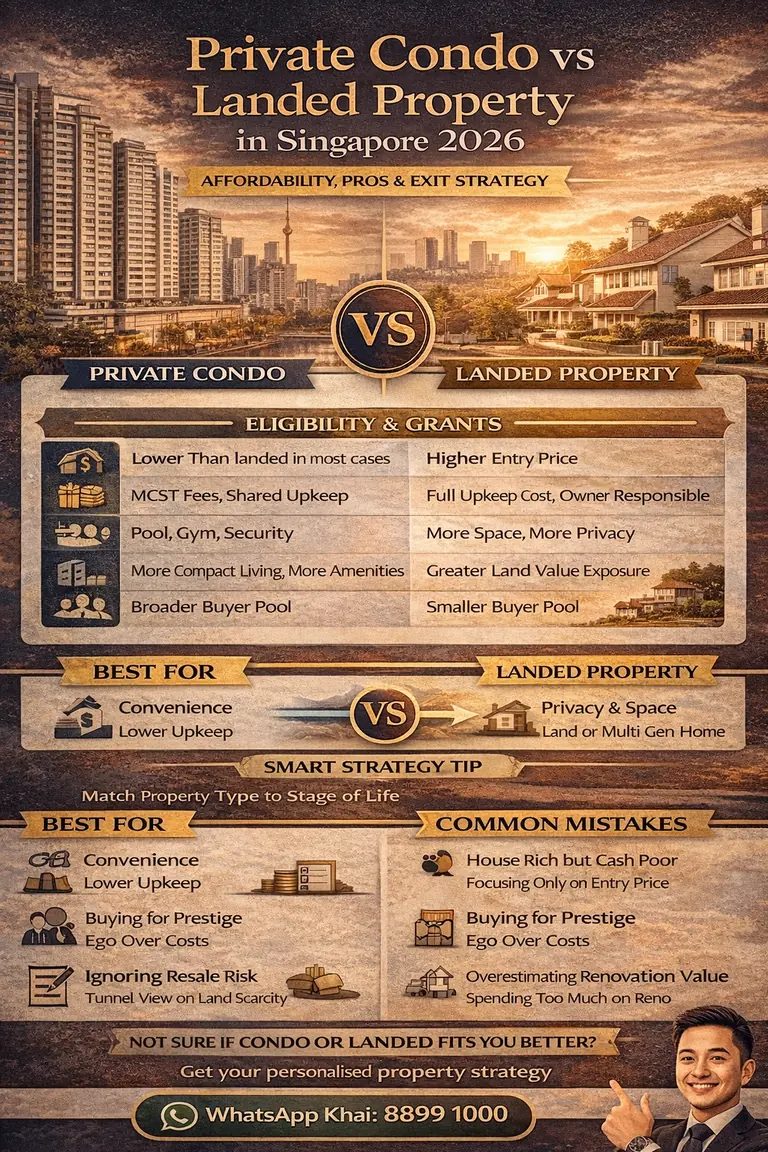
A private condo gives you convenience, facilities, security, and usually a lower maintenance burden. A landed property gives you land value, space, privacy, and status — but also higher entry price, higher upkeep, and a smaller buyer pool.
So which one is better in 2026?
The real answer is: it depends on what you want your money to do for you over the next 10 years.
Private Condo vs Landed: The Core Difference
A condo is a private residential property built for shared living with common facilities and managed upkeep. A landed property gives you direct land ownership together with the home structure, which is why many buyers see it as the “ultimate” residential asset class in Singapore.
| Factor | Private Condo | Landed Property |
|---|---|---|
| Entry Price | Lower than landed in most cases | Usually much higher |
| Maintenance | MCST fees, but shared upkeep | Owner handles full upkeep and repairs |
| Facilities | Pool, gym, security, clubhouse | Private enjoyment, but no shared facilities unless you build them |
| Space & Privacy | More compact, more shared environment | More space, more privacy, more control |
| Buyer Pool on Exit | Broader | Usually narrower due to quantum |
Khai Rambo Insight:
Condo is usually the more liquid, convenience-driven asset. Landed is usually the more emotional, prestigious, and land-value-driven asset. Neither is automatically better — only better matched.
Affordability: Which One Is Easier to Enter?
Private condos are generally easier to enter because their purchase prices, downpayments, stamp duties and renovation commitments are typically lower than for landed homes. The right comparison is not price alone: buyers should test total cash required, sustainable monthly repayments and reserves after purchase before deciding that either property type is affordable.
For most buyers, private condo is the easier entry. Landed property usually sits in a much higher quantum bracket, and that changes everything: your downpayment, your stamp duties, your financing stress, your renovation cost, and even your risk tolerance.
IRAS currently states that a Singapore Citizen buying a second residential property pays 20% ABSD, while a third and subsequent residential property attracts 30% ABSD. Its residential BSD table currently has a top marginal rate of 6%. Verify the buyer profile and transaction date.
That means for higher-value private homes, the transaction cost itself can become a major decision factor before you even talk about renovation or furniture.
Typical affordability reality
- Private condo — easier for more buyers to enter, easier to finance, more flexible from a cash-flow standpoint
- Landed property — usually requires much deeper reserves, higher confidence in long-term holding power, and stronger emergency buffer
If the purchase makes you asset-rich but cash-poor, it is not a smart upgrade. It is a stress upgrade.
Land Value: Why People Dream About Landed
Buyers value landed homes because the asset includes scarce land, greater control and space that cannot be reproduced easily in Singapore. Scarcity can support long-term wealth preservation, but it does not guarantee superior returns. Condition, plot characteristics, planning restrictions, location, entry price and the smaller buyer pool still determine performance.
The emotional appeal of landed is obvious. Bigger home. More privacy. No upstairs neighbours. More parking flexibility. More status.
But the deeper reason many buyers chase landed is simple: land is scarce.
That scarcity is why many buyers believe landed properties can preserve wealth well over long holding periods. But scarcity alone does not mean every landed home is a better investment than every condo.
You still need to evaluate:
- District and micro-location
- Plot size and frontage
- Condition of the property
- Potential rebuilding or A&A cost
- Buyer profile when you exit
Khai Rambo Insight:
Don’t buy landed just because “land always wins.” Buy the right landed in the right location at the right number. Otherwise you’re buying a story, not an asset.
Maintenance and Lifestyle: Which One Is Easier to Live With?
Private condos are usually easier to live with because management handles shared security, facilities and common-area upkeep, although owners pay maintenance fees and accept rules. Landed homes offer more privacy and control, but owners carry direct responsibility for roofs, drainage, façades, pests, security and major repairs, requiring more time and reserves.
Condo living is easier for many busy families and professionals. The building management handles common areas, security is usually integrated, and the upkeep load is much lighter for the owner.
Landed living gives you more freedom — but freedom comes with responsibility.
Condo lifestyle strengths
- Security and access control
- Shared facilities
- Less personal maintenance responsibility
- Usually easier for lock-and-leave lifestyle
Landed lifestyle strengths
- More space for multigenerational living
- More privacy and control
- Potential for customisation and rebuilding
- More parking and lifestyle flexibility
For some buyers, the best asset is not the most glamorous one. It is the one they can manage comfortably without hidden stress.
Investment Potential: Which One Has Better Upside?
Neither property type has automatically better upside. A well-priced condo can benefit from rental demand, liquidity and a broad resale pool, while a scarce landed home can preserve wealth through land exposure over a long horizon. Entry price, location, holding costs, condition and future buyer demand matter more than category alone.
This is where the debate gets interesting.
Condo can perform very well when bought at the right entry price, especially if the project has strong location fundamentals, efficient layout, and wide future demand. It is also usually easier to rent and easier to resell to a broader market.
Landed can be powerful for long-term wealth preservation and status-driven demand, but it is more capital-intensive, more renovation-sensitive, and often less liquid because the buyer pool is naturally smaller.
Condo strengths for growth
- Lower entry quantum relative to landed
- Potentially stronger liquidity
- Broader resale and rental audience
Landed strengths for wealth positioning
- Direct exposure to land value
- Scarcity appeal
- Strong prestige factor in certain locations
The question is not “Which one is richer people’s choice?” The question is “Which one gives me the best outcome based on my holding power and exit plan?”
Financing Rules Still Matter
Financing rules constrain both choices, but their impact is greater when a landed home requires a larger loan and renovation budget. Buyers should assess loan-to-value limits, total debt servicing ratio, cash and CPF needs, stamp duties and repayments under higher-rate scenarios, then retain enough liquidity for ownership costs and life changes.
MoneySense's official affordability guide explains that housing loans remain subject to LTV and TDSR rules. Affordability is not just whether a bank says yes; the mortgage must remain comfortable after rate changes, life changes and higher property-related costs.
For landed, this becomes even more important because the absolute loan size and renovation commitments can be much bigger.
Who Should Choose Private Condo?
A private condo is usually the better fit for buyers who prioritise convenient facilities, managed maintenance, security and a more accessible private-property entry point. It also suits those who want a broader rental and resale audience, provided they check maintenance fees, project competition, layout efficiency and the development’s long-term location fundamentals.
Private condo usually makes more sense if:
- You value convenience and lower upkeep
- You want a broader resale and rental market
- You want a more manageable entry into private property
- You prefer facilities and security over land and rebuilding potential
For many buyers, condo is the smarter balance between growth, affordability, and flexibility.
Who Should Choose Landed Property?
Landed property usually fits households with strong cash reserves, long holding power and a genuine need for privacy, space or multigenerational living. Buyers should be comfortable managing repairs, renovation and a less liquid resale market. The decision works best when land ownership supports long-term family goals, not status alone.
Landed usually makes more sense if:
- You have strong cash reserves and holding power
- You want privacy, space, and control over the asset
- You are planning for multigenerational living or long-term family use
- You understand the maintenance, renovation, and exit challenges
Landed is often the right move for buyers who are no longer just climbing the ladder — they are deciding how they want to hold wealth for the long run.
Biggest Buyer Mistakes
The biggest mistakes are buying landed property for prestige without reserving for upkeep, or choosing a condo without assessing competing supply and exit demand. Buyers also underestimate stamp duties, financing stress and renovation risk. A sound decision starts with total ownership cost, intended holding period and realistic future buyer appeal.
- Buying landed for status without budgeting for upkeep
- Buying condo without thinking about future competition and exit demand
- Ignoring stamp duties and financing stress
- Overestimating renovation value recovery
- Choosing based on emotion instead of long-term fit
Khai Rambo Insight:
The most expensive mistake is not buying the wrong type. It’s buying the wrong type for your stage, your cash flow, and your future exit.
So Which One Should You Buy?
Choose a private condo when convenience, managed upkeep, rental flexibility and a manageable purchase quantum matter most. Choose landed property when privacy, land exposure, family space and long-term control justify the higher capital and maintenance burden. In either case, buy only after testing affordability, holding costs and a credible exit market.
| Your Situation | Likely Better Fit |
|---|---|
| Buyer wants manageable private property entry with facilities and flexibility | Private Condo |
| Buyer wants long-term family home with land value, privacy and strong holding power | Landed Property |
| Buyer is unsure about affordability, taxes, upkeep and exit strategy | Do the numbers first before choosing either |
Condo is often the smarter balance. Landed is often the stronger statement. The better choice is the one your finances can support and your future can benefit from.
Final Thoughts
Private condos and landed homes serve different priorities, so the better purchase is the one that fits your finances, lifestyle and holding plan. Condos generally offer convenience and liquidity; landed homes offer space, privacy and land exposure. Compare total cost, maintenance capacity and exit demand rather than treating either category as universally superior.
Private condo and landed property are both premium choices, but they serve different goals.
If you want flexibility, convenience, and a more manageable entry into private property, condo is often the cleaner move.
If you want space, privacy, land exposure, and you have the financial muscle to hold comfortably, landed can be a powerful long-term asset.
The real winner is not condo or landed. The real winner is the buyer who matches the property type to the right stage of life, the right risk profile, and the right exit plan.
Frequently Asked Questions
Who should choose a private condo instead of landed property?
A private condo often suits buyers who want facilities, security, shared maintenance and a lower typical entry point than landed property. It can also offer more location and unit choices within a fixed budget. Compare monthly fees, usable space, privacy and resale supply, because some buyers will prefer land while others value convenience and easier upkeep.
Who should consider landed property in Singapore?
Landed property may suit eligible buyers who value land, privacy, space and control over the home and can fund both the purchase and ongoing upkeep. Confirm citizenship or approval requirements, structural condition, renovation, drainage, access and financing before offering. The land premium should fit a long-term plan rather than depend on quick appreciation.
Is landed property always a better investment than a condo?
No, landed property is not always a better investment than a condo. Scarcity and land value can be attractive, but the entry price, renovation, maintenance, liquidity and buyer pool differ substantially. A well-bought condo can outperform an overpriced landed home. Compare net costs, holding period and future demand within the same budget range.
Which official sources should you verify?
Property rules, financing limits, duties and market figures can change after publication. Before acting, verify the claim that affects your decision with the responsible Singapore institution below. The article’s comparisons and professional observations are general guidance; your current eligibility, loan assessment, tax position and transaction documents remain decisive.
- MoneySense Singapore property guidance
- Inland Revenue Authority of Singapore (IRAS) property guidance
- Urban Redevelopment Authority (URA) property guidance
- Council for Estate Agencies (CEA) property guidance
Source review: Primary-source links checked 17 July 2026. See the property editorial and correction policy for the evidence standard.
Not Sure If Condo or Landed Fits You Better?
Get a personalised strategy based on your budget, taxes, financing room, lifestyle needs and long-term property goals.
WhatsApp Khai Rambo Get Free Valuation