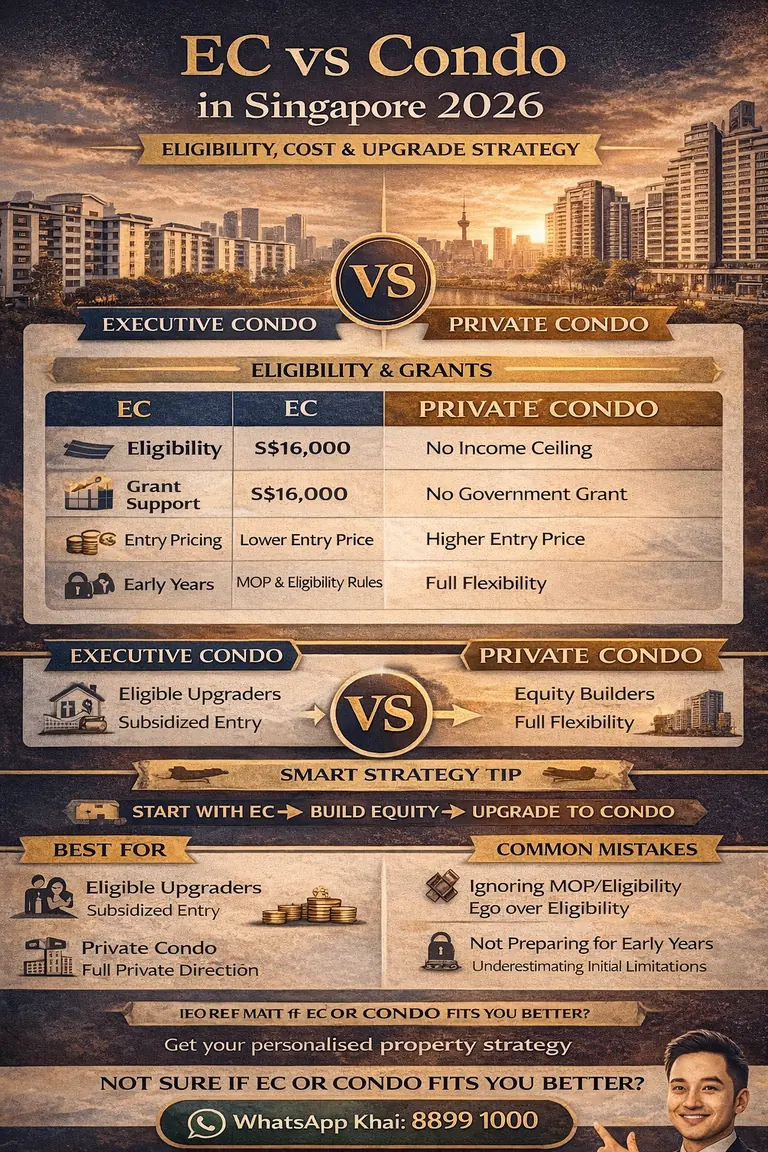
Executive Condo or private condo? In Singapore, this is one of the most important decisions for upgraders who want condo living without jumping straight into full private prices.
And this is where many buyers get confused. They hear that EC is the “cheap condo.” Others say just go straight to private condo. But the truth is simple:
EC and condo are not just two price points. They are two very different strategies.
An Executive Condominium comes with eligibility rules, income ceiling, grant support and ownership conditions. A private condo gives you more flexibility, but also higher cost and fewer buyer protections. HDB's new-EC eligibility page currently lists a S$16,000 monthly household income ceiling, while its EC grant page states that eligible buyers may receive up to S$30,000.
In this guide, I’ll break down which one makes more sense in 2026 depending on your budget, goals, and future exit plan.
EC vs Condo: The Core Difference
An executive condominium begins with HDB-style eligibility, income and ownership restrictions before becoming fully privatised on the applicable timeline. A private condo is private property from the outset, without the same standard HDB buyer criteria. The core trade-off is therefore EC’s supported entry and restrictions versus private condo’s greater immediate flexibility.
An EC is a hybrid product. It starts as a subsidised housing type with eligibility rules and certain restrictions, then later becomes fully privatised after the relevant timeline. A private condo is private from day one and does not have HDB-style eligibility criteria. HDB's official EC buying process links the eligibility, application and post-purchase conditions.
| Factor | Executive Condo | Private Condo |
|---|---|---|
| Eligibility Rules | Yes | No standard HDB-style eligibility rules |
| Income Ceiling | S$16,000 household ceiling for new EC applications | No income ceiling |
| Grant Support | Up to S$30,000 CPF Housing Grant for eligible buyers | No EC housing grant |
| Entry Pricing | Usually lower than comparable private condos | Usually higher |
| Flexibility | More restricted in early years | More flexible from the start |
Khai Rambo Insight:
EC is not just a cheaper condo. It is a strategic bridge between HDB and private property — if you fit the rules and buy the right one.
Why EC Attracts So Many Upgraders
ECs attract upgraders because they can offer condo facilities and a lower entry point than many private developments, with grant support for qualifying households. That combination can preserve more cash while creating a route into private-style housing, provided the buyer satisfies eligibility rules and chooses a sound project at a sensible price.
The appeal is obvious. Many buyers want the condo lifestyle, but they do not want full private condo pricing immediately. EC fills that gap.
- Lower entry point versus many private condos
- Possible grant support for eligible buyers
- Facilities and condo-style environment
- Potential upside if bought at the right project and price
EC interest should be assessed project by project, using the current HDB eligibility framework, developer documents, financing approval and comparable transactions rather than unsourced market commentary or launch hype.
Who Can Buy an EC?
HDB states that to buy a new EC from a developer, applicants and listed persons must meet the relevant eligibility conditions, and the monthly household income ceiling must not exceed S$16,000. HDB also guides buyers through the application outcome, booking and document signing stages in its official EC buying process.
Common EC checkpoints
- Citizenship / family nucleus requirements
- Household income ceiling
- Private property ownership rules
- Compliance with application process and timelines
This is one of the biggest reasons some buyers should not blindly chase EC. If you do not qualify, then the discussion is over before it even starts.
What About Grants?
HDB states that eligible buyers may receive up to S$30,000 under the CPF Housing Grant Scheme for buying an EC. That grant can materially improve the numbers, especially for buyers trying to preserve more cash for renovation, emergency buffer or other commitments.
That said, the wrong mindset is “I have grant, so must buy EC.” The right mindset is “Does the grant improve an already sensible decision?”
| Topic | Why It Matters |
|---|---|
| EC Housing Grant | Can reduce effective purchase cost |
| Income Ceiling | Determines whether you even qualify |
| Eligibility Rules | Affects whether EC is truly an option for you |
Cost: Which One Is Easier to Enter?
An EC is generally easier to enter for an eligible household because its price may be lower than a comparable private condo and qualifying buyers may receive grant support. However, affordability still depends on the project, layout, location, surrounding supply and repayments; a cheaper sticker price does not make a weak purchase good.
In general, EC is usually the easier stepping-stone into condo-style living. Private condo often needs a larger upfront commitment and does not come with EC-style grant support.
But there is a trap here too: cheaper entry does not automatically mean better deal.
You still need to study:
- Entry price versus surrounding private condos
- Project location
- Future supply nearby
- Unit layout efficiency
- Your real repayment comfort zone
A lower entry price only helps if the project itself is strong.
Upside Potential: Which One Can Make More Money?
Neither EC nor private condo automatically makes more money. EC may benefit from a lower relative entry price and eventual privatisation, while private condo offers greater flexibility and a wider buyer or tenant pool from the start. Actual upside depends on purchase price, location, supply, layout, holding period and exit demand.
This is where everyone gets excited. And where many buyers become dangerously overconfident.
EC can have a compelling value proposition because it may enter the market below fully private condo pricing while still offering condo-style living. Private condo, however, offers greater flexibility and a wider buyer/renter universe from the start.
EC strengths
- Often more attractive relative entry price
- Grant support may improve total economics
- Can be a powerful upgrader route
Private condo strengths
- More flexibility from day one
- Wider marketability
- No EC-specific buyer restrictions
Khai Rambo Insight:
EC can be a golden bridge to private property. But only if the bridge leads somewhere strong — not just somewhere flashy.
When Does Private Condo Make More Sense?
Private condo makes more sense when you do not meet EC rules, exceed the income ceiling, want fewer ownership restrictions or can comfortably fund the higher cost. It is also the cleaner option when flexibility, immediate marketability and a wider tenant or buyer pool matter more than subsidised entry or EC grants.
A private condo usually makes more sense when:
- You do not qualify for EC
- Your household income is above the EC ceiling
- You want maximum ownership flexibility
- You are prepared for the higher cost structure
If you are already financially strong enough and flexibility matters more than subsidised entry, then a private condo can be the cleaner move.
Biggest Buyer Mistakes
The biggest mistakes are pursuing an EC before checking eligibility, treating a grant as the main reason to buy, ignoring location or future supply, comparing launch hype instead of exit demand, and choosing private condo for status. Both paths still require disciplined affordability checks and project-level due diligence.
- Chasing EC without checking eligibility first
- Using grants as the main reason to buy
- Ignoring layout, location and future supply
- Comparing only launch hype, not long-term exit demand
- Buying private condo for status instead of numbers
Whether you buy EC or condo, the wrong project can still become a weak asset.
So Which One Should You Buy?
Choose EC if you qualify, value a potentially lower entry point and accept the early ownership restrictions. Choose private condo if flexibility matters more and the full private cost is comfortable. If neither option survives a conservative review of cash flow, project quality and exit demand, delay the choice and strengthen the numbers.
| Your Situation | Likely Better Fit |
|---|---|
| Eligible upgrader who wants condo lifestyle at a more strategic entry point | EC |
| Buyer wants flexibility and is comfortable with full private pricing | Private Condo |
| Buyer still uncertain on eligibility, affordability and exit strategy | Do the numbers first before choosing either |
If you qualify and buy right, EC can be a smart stepping-stone. If you need flexibility and can afford it, private condo may be cleaner.
Final Thoughts
EC and private condo serve different buyers: EC can suit eligible upgraders seeking a strategic entry with restrictions, while private condo can suit those prioritising flexibility and able to bear the higher cost. The right answer comes from matching eligibility, affordability, project quality, timeline and future exit demand to your household.
EC and private condo are both powerful options — but for different buyers at different stages.
The smart move is not asking which one sounds better. The smart move is asking which one fits your numbers, your timeline, and your future exit.
That is how you stop buying emotionally and start positioning strategically.
Frequently Asked Questions
Who can buy a new executive condominium in Singapore?
A new EC buyer must satisfy the current eligibility framework published by HDB, including the applicable household, income, property-ownership and scheme conditions. Resale EC and fully privatised EC purchases may follow different rules. Check your household against the official criteria for the specific project and application date before relying on an agent's general summary.
Can eligible buyers receive a grant for a new EC?
Some eligible first-timer households may receive a CPF Housing Grant for a new EC, subject to current HDB rules and household circumstances. Do not assume the maximum amount in your budget. Confirm the grant shown for your application, along with CPF usage, downpayment and loan terms, before deciding what purchase price is comfortably affordable.
Is an EC a better investment than a private condo?
An EC is not automatically a better investment than a private condo. Its entry structure can be attractive for eligible buyers, but restrictions, location, project quality, supply and the price paid all shape the outcome. Compare both options over the same holding period with realistic costs, rent and resale assumptions before choosing.
Which official sources should you verify?
Property rules, financing limits, duties and market figures can change after publication. Before acting, verify the claim that affects your decision with the responsible Singapore institution below. The article’s comparisons and professional observations are general guidance; your current eligibility, loan assessment, tax position and transaction documents remain decisive.
- Housing & Development Board (HDB) property guidance
- Central Provident Fund Board (CPF) property guidance
- MoneySense Singapore property guidance
- Inland Revenue Authority of Singapore (IRAS) property guidance
Source review: Primary-source links checked 17 July 2026. See the property editorial and correction policy for the evidence standard.
Not Sure If EC or Condo Fits You Better?
Get a personalised strategy based on your budget, eligibility, upgrade goals and long-term exit plan.
WhatsApp Khai Rambo Get Free Valuation