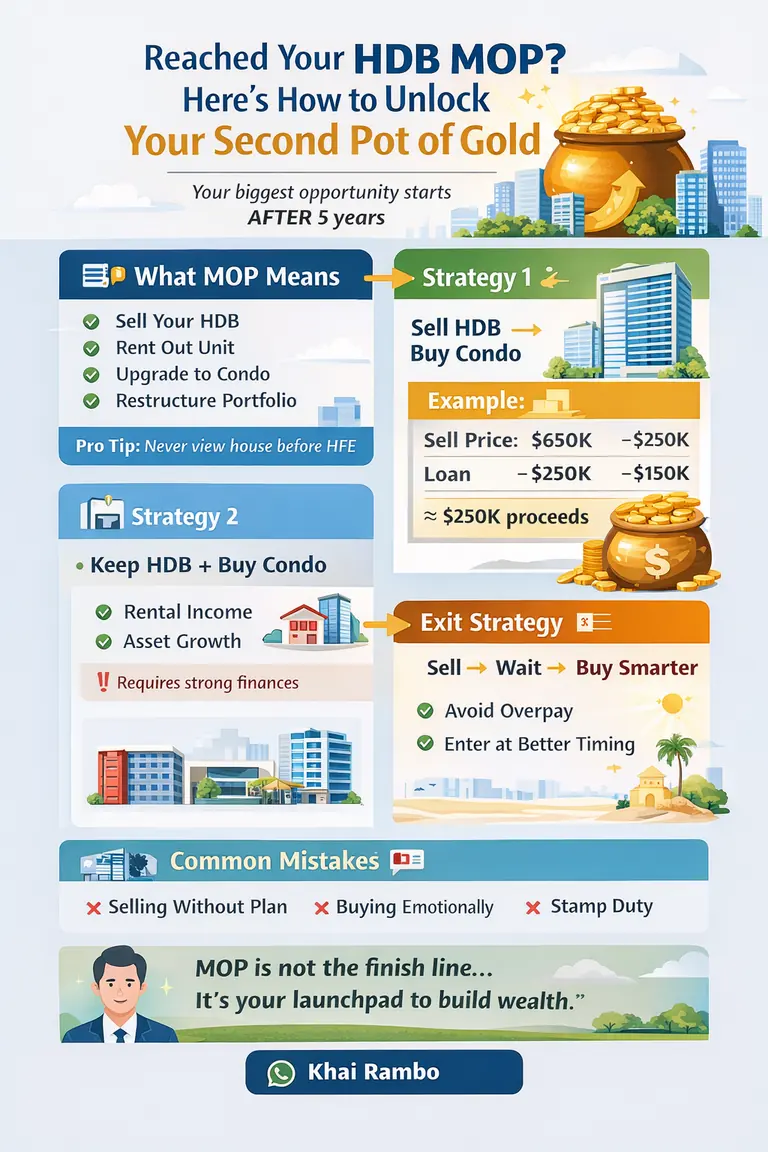
Most HDB owners think their journey ends after reaching MOP… But that's actually where the real opportunity begins.
If you've just completed your Minimum Occupation Period (MOP), you're sitting on something powerful: Equity. Options. Opportunity.
The question is — will you unlock it… or let it sit idle?
In this guide, I'll explain how HDB owners in Singapore can compare upgrading, retaining or restructuring after MOP. These are planning frameworks, not a promise of profit or evidence that one strategy will outperform.
What Happens After MOP? Understanding Your Options
After completing the HDB Minimum Occupation Period, eligible owners can sell the flat, rent out the whole unit or plan a move into private property, subject to current HDB rules. The right option depends on net equity, housing needs, income resilience and whether holding, upgrading or restructuring best supports the household's next five years.
Once your flat meets the applicable HDB Minimum Occupation Period and resale conditions, additional sale, rental or upgrade options may become available. Check the exact rules for the flat classification and purchase scheme rather than assuming every MOP is identical.
After MOP, You Can:
- Sell your HDB — unlock your equity and capital appreciation
- Rent out the whole unit — generate passive income while you live elsewhere
- Upgrade to a private property — move into a condo with better growth potential
- Restructure your property portfolio — strategically reposition for maximum returns
But Here's the Reality
Most owners don't maximise this stage. They either stay stagnant because it feels safe, make emotional decisions driven by FOMO, or miss critical timing opportunities in the market cycle.
The difference between an HDB owner who stays comfortable and one who builds wealth comes down to one thing: strategy.
Khai Rambo Insight:
MOP is a review point, not a guaranteed launchpad to profit. Planning ahead helps owners compare options, costs and risks before committing.
Strategy 1: Sell Your HDB and Upgrade to Private Property
Selling the HDB and buying private property can convert accumulated equity into the next home's downpayment while restoring flexibility after the sale. It works best when net proceeds, loan eligibility, buyer's stamp duty, monthly costs and the condo's resale demand all support the move without exhausting emergency cash.
This is the most common upgrade path — but also the most misunderstood. Many owners rush into the first condo they see without understanding the numbers.
Why Upgrading Works
- Different market exposure — compare actual URA and HDB transaction indices instead of assuming private homes always appreciate faster
- Different ownership rules — private homes do not use HDB's standard MOP framework, but stamp-duty and financing rules still constrain exits
- Better exit options — wider pool of buyers including foreigners and PRs
- Rental potential — assess project-specific rent, vacancy, maintenance and tenant demand rather than assuming condos always yield more
Illustrative Example: How the Numbers Work
The table below is a worked assumption, not a valuation or client record. Replace every figure with the actual sale price, loan redemption statement, CPF refund and transaction costs.
| Component | Amount |
|---|---|
| HDB Selling Price | $650,000 |
| Outstanding Loan | ($250,000) |
| CPF Refund (OA + Accrued Interest) | ($150,000) |
| Cash/CPF Proceeds for Next Purchase | ~$250,000 |
In this arithmetic example, S$250,000 could support a S$1,000,000 purchase only if the buyer qualifies for a 75% LTV and can separately fund duties, fees and reserves. A bank's approved LTV and loan amount may be lower.
Khai Rambo Insight:
Don't just upgrade to "any condo". Upgrade to one that has strong exit demand, good entry price, and real growth potential. The wrong condo can cost you more than staying in your HDB.
Strategy 2: Keep Your HDB and Buy Private Property (Advanced Play)
Keeping the HDB while purchasing private property creates exposure to two assets and may add rental income, but it is an advanced, capital-intensive strategy. Buyers must absorb applicable ABSD, satisfy TDSR and downpayment rules, withstand vacancies and repairs, and confirm that projected returns justify the added debt and concentration risk.
Some owners choose a bolder strategy: keep the HDB and buy a private property on top of it. This is the dual-property approach.
How It Works
- Keep your HDB and rent it out for passive income
- Purchase a private property for your own stay or as a second investment
- Benefit from capital appreciation on both properties simultaneously
Reality Check: Who Can Do This?
This strategy is only possible if you meet specific criteria:
- ABSD (Additional Buyer's Stamp Duty) — IRAS currently lists 20% for a Singapore Citizen buying a second residential property; verify the ownership count and any remission conditions.
- TDSR (Total Debt Servicing Ratio) — MoneySense explains the current 55% TDSR threshold, but a lender may approve less after its credit assessment.
- Sufficient cash/CPF — downpayment for the second property must come from your own funds
When Does This Make Sense?
If your HDB rental income covers (or nearly covers) your HDB mortgage, and the private property you're buying has strong appreciation potential, the math can work in your favour — but only if your finances are structured correctly.
Khai Rambo Insight:
This strategy is powerful… but it's not for everyone. I've seen owners succeed spectacularly with this — and others get overextended. The difference is always in the numbers. Get them right before you commit.
Strategy 3: Sell, Reposition, and Re-enter Smarter
Selling first and re-entering later can improve bargaining power and prevent a rushed purchase, especially when suitable homes are overpriced or scarce. The strategy only works with a realistic temporary-housing plan, disciplined entry criteria and acceptance that market timing is uncertain; waiting should be purposeful, not an open-ended attempt to catch the bottom.
This is the strategy most people overlook — and it's one of the most powerful.
Instead of rushing into the next purchase immediately after selling your HDB, you:
- Sell your HDB at the right timing to maximise proceeds
- Reassess the market — wait for the right entry point
- Enter at a better opportunity window — buy when others are hesitant
Why This Works
- Avoid overpaying — you're not buying in a rush or at peak market prices
- Increase long-term gains — better entry price = more appreciation potential
- Reduce financial stress — you have cash in hand and full flexibility
The Temporary Housing Question
Temporary accommodation has a real cost and waiting does not guarantee a cheaper purchase. Compare rent, storage, two moves and market risk against a clearly defined target discount before choosing this sequence.
Khai Rambo Insight:
Timing the market perfectly is hard. But positioning yourself strategically — selling high and buying at fair value — is absolutely possible with the right guidance.
Strategy 4: Choose Your Next Property Based on Exit Strategy
Choose the next property by planning the eventual exit before purchase: identify the likely future buyer, affordable resale quantum and features that keep demand broad. MRT access, efficient layouts, schools, amenities and upcoming infrastructure matter, but they must be weighed against entry price, holding costs and the intended five-to-ten-year timeline.
Most buyers ask: "Can I afford this?"
Smart buyers ask: "Who will buy this from me in 5 years?"
This one question changes everything. It shifts your mindset from consumer to investor — and that's how you build real wealth in property.
What to Look For in Your Next Property
| Factor | Why It Matters |
|---|---|
| MRT Proximity | Within 500m = higher demand, easier exit |
| Good Layout | Efficient floor plans attract more buyers |
| Nearby Developments | New MRT lines, malls, and commercial hubs drive prices up |
| School Proximity | Properties near popular schools are always in demand |
| Quantum (Entry Price) | Lower entry price = wider buyer pool on exit |
Khai Rambo Insight:
Profit is made when you buy right, not when you sell. Every property decision should start with one question: "What's my exit?"
Hidden Costs You Must Prepare For When Upgrading
An HDB-to-private-property upgrade costs more than the purchase price. Budget for buyer's stamp duty, legal fees, valuation, agent commission on the sale, renovation, moving, temporary accommodation, maintenance fees and a cash reserve. Also calculate CPF refunds and loan redemption so headline sale proceeds are not mistaken for usable funds.
Before you commit to any upgrade path, budget for these costs that most owners forget:
Evidence note: The BSD and ABSD examples use the current IRAS stamp-duty framework. Legal, agency, renovation and rental amounts are illustrative planning ranges only; obtain transaction-specific quotes.
| Cost | Estimated Amount |
|---|---|
| Buyer Stamp Duty (BSD) | $24,600 (on $1M property) |
| ABSD example (SC buying second home) | 20% of purchase price |
| Legal Fees | $3,000–$5,000 |
| Agent Commission (selling HDB) | 1–2% of sale price |
| Renovation (new property) | $50,000–$150,000 |
| Temporary Housing (if needed) | $2,500–$4,000/month |
Common Mistake
Underestimating cash flow during the transition period. If there's a gap between selling your HDB and collecting keys for the new property, you'll need to budget for temporary housing, storage costs, and double agent commissions.
Khai Rambo Insight:
The biggest financial surprise for upgraders is not the property price — it's the hidden costs they didn't plan for. Map out every dollar before you commit.
Illustrative Case Study: Testing an HDB-to-Condo Upgrade
This illustrative composite compares an overstretched S$1.2 million condo target with a hypothetical S$980,000 alternative. The assumptions add S$30,000 of sale proceeds and keep payments below 30% of income to demonstrate buffer planning. They are not a documented client result, valuation, transaction record or forecast of future appreciation.
Illustrative assumptions: A fictional couple has met the applicable MOP on a four-room Tampines HDB and is comparing an immediate condo upgrade.
The scenario's initial plan is to sell the HDB and target a S$1.2 million condo.
After a detailed financial review, we discovered:
- Their HDB proceeds would only cover the minimum downpayment — leaving no cash buffer
- The condo they wanted was overpriced relative to comparable units
- Their monthly mortgage would stretch to 45% of income — dangerous territory
What we did instead:
- Analysed market trends — identified that nearby launches were coming, which would put downward pressure on resale prices
- Assumed HDB proceeds S$30,000 above the initial planning figure
- Compared a hypothetical S$980,000 alternative with the S$1.2 million target
- Modelled monthly payments at under 30% of income
Illustrative result: The lower target leaves more buffer under the stated assumptions. It does not establish appreciation potential or guarantee a later upgrade.
The lesson: It's not about upgrading fast… it's about upgrading smart.
Your Step-by-Step Plan After MOP
A sound post-MOP plan starts by valuing the HDB and calculating true net proceeds, then checking loan eligibility before choosing whether to hold, sell, upgrade or reposition. Shortlist the next homes against affordability and exit criteria, and coordinate sale, purchase, financing and temporary housing timelines before committing.
Follow this framework to make the most of your MOP window:
- Review your HDB's current market value — get a free valuation to understand where you stand
- Calculate your net sale proceeds — selling price minus outstanding loan minus CPF refund
- Check your loan eligibility — how much can you borrow for your next property?
- Define your strategy — sell and upgrade? Keep and invest? Reposition?
- Shortlist properties — based on exit strategy, not just personal preference
- Execute with professional guidance — timing, negotiation, and financial structuring matter
This is where most owners need guidance. The difference between a good upgrade and a great one often comes down to the details.
6 Common Mistakes HDB Owners Make After MOP
The most damaging post-MOP mistakes are selling before planning the next move, overstating usable proceeds, buying emotionally, ignoring market timing, choosing weak locations and neglecting the eventual exit. Each error can reduce flexibility or returns, so decisions should be tested against full costs, future demand and a realistic household cash buffer.
- Selling without a plan — listing your HDB before knowing what you'll buy next
- Overestimating their budget — forgetting about ABSD, BSD, renovation, and transition costs
- Buying based on emotion — choosing a condo because it "feels nice" instead of analysing the numbers
- Ignoring market timing — buying at peak prices because "everyone else is buying"
- Choosing a poor location — prioritising facilities over MRT access and future demand
- Not thinking about exit — buying a property that will be hard to sell in 5–10 years
Khai Rambo Insight:
Each mistake can reduce cash flow, flexibility or eventual proceeds. The impact is transaction-specific, so do not rely on a generic six-figure loss claim when assessing your own options.
Final Thoughts
Completing MOP creates options, not an automatic reason to sell or upgrade. The strongest next move is the one that converts equity into better long-term flexibility without overextending the household: understand net proceeds, compare viable strategies, buy with an exit plan and reserve enough cash for duties, renovation and surprises.
Reaching MOP creates options, but it does not make an upgrade the household's biggest or most profitable opportunity automatically.
If done right, you don't just upgrade your home — you upgrade your financial future.
The owners who succeed are the ones who:
- Understand their options after MOP
- Choose the right strategy for their financial situation
- Buy based on exit strategy, not emotion
- Plan for all costs — visible and hidden
- Work with an advisor who has a proven track record
Your second pot of gold is waiting. The only question is — will you claim it?
Frequently Asked Questions
Can I sell my HDB immediately after completing MOP?
You can generally market and sell an HDB flat after the applicable Minimum Occupation Period has been fulfilled, subject to the current HDB conditions for your flat and household. Confirm the official completion date before granting an Option to Purchase. Also calculate the outstanding loan, CPF refund, selling costs and realistic net proceeds before planning the next purchase.
Can I keep my HDB and buy private property after MOP?
Some owners can retain an HDB flat and buy private property after MOP, but ownership rules, financing limits, stamp duties and cash flow can make this an expensive strategy. Confirm current eligibility and tax treatment for every owner. Compare the retained-flat scenario with selling first, including rent, maintenance, vacancy and the larger upfront cash requirement.
What costs matter when upgrading from HDB to condo?
Include the outstanding HDB loan, CPF principal and accrued interest refund, selling fees, condo downpayment, Buyer's Stamp Duty, possible Additional Buyer's Stamp Duty, legal fees, renovation and temporary housing or bridging costs. Model the sequence with actual completion dates, because a profitable-looking upgrade can become stressful when deposits and sale proceeds do not align.
Which official sources should you verify?
Property rules, financing limits, duties and market figures can change after publication. Before acting, verify the claim that affects your decision with the responsible Singapore institution below. The article’s comparisons and professional observations are general guidance; your current eligibility, loan assessment, tax position and transaction documents remain decisive.
- Housing & Development Board (HDB) property guidance
- Central Provident Fund Board (CPF) property guidance
- MoneySense Singapore property guidance
- Inland Revenue Authority of Singapore (IRAS) property guidance
Source review: Primary-source links checked 17 July 2026. See the property editorial and correction policy for the evidence standard.
Not Sure What to Do After Your MOP?
Get a personalised upgrade strategy based on your HDB value, finances, and goals — at no cost.
WhatsApp Khai Rambo Get Free Valuation