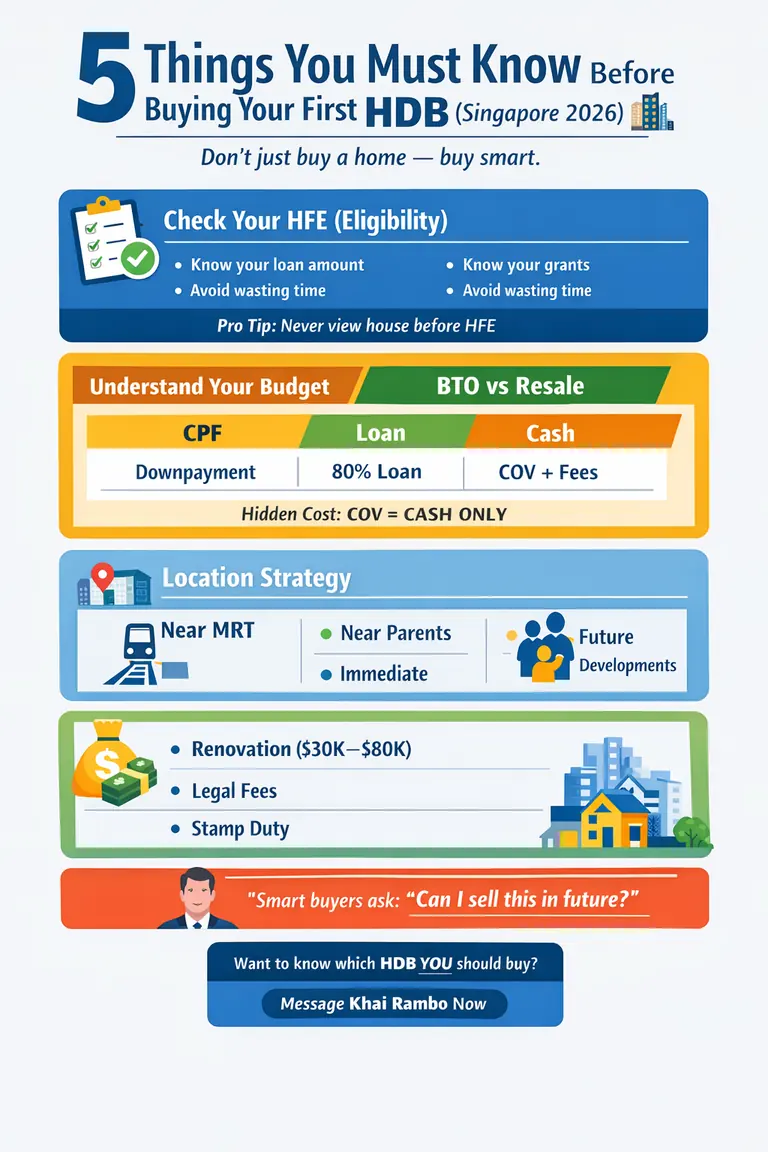
Most Singaporeans don't lose money buying an HDB flat… They lose money when they choose the wrong one.
Buying your first HDB is one of the biggest financial decisions you'll ever make. And in today's market — where prices are rising, loan limits are tighter, and competition is strong — going in without a strategy can cost you tens of thousands of dollars.
But here's the good news: if you understand the right framework, you don't just buy a home… You position yourself for your next upgrade.
In this guide, I'll break down the 5 most important things you must know before buying your first HDB flat in Singapore, so you can make a confident and profitable decision.
1. Check Your HDB Eligibility (Get Your HFE Letter First)
Get your HFE letter before viewing flats because it confirms whether you can buy, estimates available grants, and sets out your HDB loan options. With those figures, you can define a safe search budget, avoid unsuitable homes, and make offers based on verified eligibility instead of assumptions or emotion.
Before you even start viewing flats, secure your HFE (HDB Flat Eligibility) letter through HDB.
The HFE letter determines three critical things:
- Your maximum loan amount — how much HDB or the bank will lend you
- Your CPF usage — how much you can withdraw from your Ordinary Account
- Your grant eligibility — the schemes and amounts HDB confirms for your household
Without the HFE letter, you are basically guessing your budget.
Common Mistake
Many first-time buyers start house-hunting before getting their HFE. They view units, fall in love with a flat, then realise they can't afford it. This leads to wasted time, emotional disappointment, and poor decision-making under pressure.
Pro Tip
Always get your HFE before viewing. HDB's current HFE guidance states the letter is valid for nine months; verify that period again if your search extends beyond publication.
Khai Rambo Insight:
Eligibility is not just about whether you can buy. It's about knowing how much you should safely spend — so you don't get stuck later. Smart buyers focus on exit strategy from day one.
2. Know Your Real Budget (CPF + Loan + Cash)
Your real HDB budget is the amount your CPF savings, approved loan and available cash can support without exhausting your safety buffer. Calculate the downpayment, monthly instalments, Cash Over Valuation, legal fees and renovation together, then choose a price below your maximum if the full commitment would strain your finances.
Most first-time buyers think: "If I can afford the monthly instalment, I can buy."
That's dangerous thinking.
Your real budget is made up of three components:
CPF Savings
Your CPF Ordinary Account can be used for downpayment and monthly mortgage instalments. Check your available balance early.
Loan (HDB Loan or Bank Loan)
HDB's current housing-loan guidance sets out the applicable loan-to-value limit and eligibility, while MoneySense explains the 30% MSR. Do not assume every buyer receives the maximum: the approved amount depends on the current rules and the household's assessment.
Cash
You'll need cash for:
- COV (Cash Over Valuation) — the amount above HDB's valuation, payable in cash only
- Legal fees — typically $2,000–$3,000
- Renovation — budget $30,000–$80,000 for resale flats
Planning assumption: The legal and renovation ranges above are illustrative allowances, not official prices. Obtain a conveyancing quote and several itemised renovation quotes for the actual flat.
Illustrative Budget Breakdown
The figures below demonstrate how components add together; they are not a loan offer, grant assessment or recommended purchase budget. Replace them with the amounts confirmed in the HFE and the household's actual cash position.
| Component | Amount |
|---|---|
| CPF (Ordinary Account) | $120,000 |
| HDB Loan (80%) | $400,000 |
| Cash (COV + fees) | $20,000 |
| Total Budget | $540,000 |
Khai Rambo Insight:
Buying at your maximum budget is risky. Buying slightly below your limit gives you flexibility, safety, and — most importantly — better upgrade options later.
3. BTO vs Resale HDB: Which One Should You Choose?
Choose BTO when lower subsidised pricing matters most and you can wait several years for completion. Choose resale HDB when you need a home sooner, want a specific location or prefer inspecting the actual unit. The better option is the one that fits your timeline, budget and future resale plan.
One of the biggest decisions every first-time HDB buyer faces: BTO or Resale?
| Factor | BTO | Resale |
|---|---|---|
| Price | Lower | Higher (market rate) |
| Waiting Time | Project-specific construction timeline | Transaction-specific completion timeline |
| Location Choice | Limited | Flexible |
| Condition | Brand new | Older (may need reno) |
| Grants | Enhanced CPF Housing Grant | CPF Housing Grant + PHG |
BTO (Build-To-Order)
Best for eligible buyers who can wait for the chosen project's construction timeline. You get a brand-new flat at subsidised prices, but location choices depend on HDB's available sales exercises.
Resale HDB
Best for buyers who need to move in quickly or want a specific location. Prices are higher and renovation may be needed, but you get immediate occupancy and far more flexibility.
Khai Rambo Insight:
Don't just choose based on price. Choose based on where your future buyer will want to live. That's how you win the long game.
4. Location Strategy: Don't Just Buy — Position
Choose an HDB location for both daily convenience and future buyer demand. Prioritise reliable transport, useful amenities, efficient access to schools or family, and credible planned improvements. A flat with enduring location advantages is generally easier to enjoy now, market later and use as a stepping-stone toward your next property.
Location is not just about convenience. It's about future demand.
The smartest first-time buyers think about location from an investment angle:
MRT Access
MRT access can broaden buyer demand, but there is no universal 500-metre premium. Compare like-for-like records in the official HDB resale transaction dataset before paying extra for proximity.
Near Parents (Proximity Housing Grant)
If an eligible family buys a resale flat within 4km of its parents' or child's home, HDB currently lists a S$20,000 Proximity Housing Grant. Check the full household and proximity conditions before budgeting it.
Future Developments
Look out for:
- New MRT lines (Cross Island Line, Jurong Region Line)
- Upcoming malls and commercial hubs
- URA Master Plan transformation areas
Confirmed infrastructure may change convenience and demand, but it does not guarantee appreciation. Compare the plan, delivery timeline, entry price and actual transactions before assigning value to a future development.
Khai Rambo Insight:
A good location helps you live comfortably. A strategic location helps you make money when you sell.
5. Understand Hidden Costs (This Is Where Buyers Get Shocked)
Budget beyond the advertised flat price because stamp duty, legal work, renovation, furniture, appliances and any Cash Over Valuation can materially increase the total outlay. Keep these costs separate from your emergency reserve, obtain renovation quotes early and confirm the cash-only portions before committing to a purchase.
Many first-time buyers underestimate the true cost of buying an HDB flat. The purchase price is only part of the equation.
Key Costs to Prepare For
- Buyer Stamp Duty (BSD) — calculated on purchase price or market value
- Legal fees — $2,000–$3,000 for conveyancing
- Renovation — $30,000–$80,000 for resale; $20,000–$50,000 for BTO
- Furniture & appliances — $5,000–$15,000
- COV (Cash Over Valuation) — payable fully in cash
Evidence note: Calculate BSD with the current IRAS residential BSD rates. The other figures are broad planning assumptions and must be replaced with actual legal, contractor and supplier quotes.
Renovation Reality
Resale flats — especially older ones — can require significant renovation. Hacking, re-tiling, electrical rewiring and plumbing vary greatly by condition and scope, so always obtain multiple itemised contractor quotes before committing.
Common Mistake
Buyers spend all their savings on the purchase, then struggle with renovation costs. Some even take personal loans for renovation — adding unnecessary debt.
Khai Rambo Insight:
Don't just budget to buy the house. Budget to live comfortably after buying. That's what separates smart buyers from stressed buyers.
Illustrative Case Study: Preserving S$80,000 of Headroom
This illustrative composite shows a couple replacing an initial S$600,000 target with a safer S$520,000 budget after reviewing their HFE, CPF and loan position. They then compare well-connected flats with comfortable repayments, preserving roughly S$80,000 of borrowing headroom while improving flexibility. The figures are assumptions, not a documented client result.
Illustrative assumptions: A first-time couple initially targets a S$600,000 resale flat.
In the worked scenario, their verified HFE, CPF balances and preferred safety buffer reduce the planning budget to S$520,000.
Instead of stretching their finances, we helped them secure a well-located unit:
- Within 5 minutes walk to MRT
- Strong future buyer demand (near upcoming developments)
- Lower risk with comfortable monthly payments
The example illustrates affordability discipline only; it does not predict price growth or guarantee that a future upgrade will be possible.
The lesson: Buying smart is not about buying the biggest or most expensive flat. It's about buying the right one.
5 Common Mistakes First-Time HDB Buyers Make
First-time HDB buyers most often lose flexibility by viewing before HFE approval, buying emotionally, spending at their maximum, overlooking future resale demand or over-renovating. Avoid these errors by verifying the numbers first, keeping a cash buffer, comparing locations objectively and treating the flat as both a home and a future sale.
- Buying based on emotion, not data — falling in love with a unit before checking the numbers
- Not getting HFE early — wasting weeks viewing flats you can't afford
- Overstretching the budget — buying at maximum capacity leaves zero buffer
- Ignoring future resale demand — choosing a unit no one will want to buy later
- Over-renovating — spending $80K on renovation for a flat you'll sell in 5 years
Khai Rambo Insight:
Each mistake can weaken affordability or resale flexibility. Avoiding them improves the decision, but it does not guarantee profit or a particular ranking among buyers.
Final Thoughts
A smart first HDB purchase begins with verified eligibility, a complete budget and a choice that suits both current needs and the eventual exit. Secure the HFE first, compare BTO and resale honestly, favour durable locations and reserve enough for hidden costs so the home supports, rather than limits, your next move.
Buying your first HDB flat is not just about getting a home — it's about making a strategic financial decision that affects your next 5–10 years.
If you follow these 5 principles:
- Secure your HFE letter first
- Understand your real budget
- Choose between BTO and resale wisely
- Focus on strategic location
- Plan for all hidden costs
You won't just buy safely — you'll buy smart.
Frequently Asked Questions
Do I need an HFE letter before viewing HDB flats?
Yes, obtain an HFE letter before seriously shopping for an HDB flat. It confirms your eligibility, estimated housing grants and available HDB loan, giving you a realistic price ceiling before emotions enter the decision. Because circumstances and policies can change, use the current HDB portal result rather than an old estimate or verbal assumption.
How much cash should a first-time HDB buyer prepare?
Your cash requirement depends on the loan, valuation and condition of the flat. Budget for any cash over valuation, the cash portion of a bank-loan downpayment, legal and administrative fees, moving costs and renovation. Keep a separate emergency reserve so completing the purchase does not leave your household without a practical safety buffer.
Should a first-time buyer choose BTO or resale HDB?
Choose BTO when lower subsidised pricing matters and you can accept the waiting time and available locations. Choose resale when you need a home sooner or require a specific town, layout or school zone. Compare the full cost, grants, renovation, lease and future demand instead of deciding from purchase price alone.
Which official sources should you verify?
Property rules, financing limits, duties and market figures can change after publication. Before acting, verify the claim that affects your decision with the responsible Singapore institution below. The article’s comparisons and professional observations are general guidance; your current eligibility, loan assessment, tax position and transaction documents remain decisive.
- Housing & Development Board (HDB) property guidance
- Central Provident Fund Board (CPF) property guidance
- MoneySense Singapore property guidance
- Inland Revenue Authority of Singapore (IRAS) property guidance
Source review: Primary-source links checked 17 July 2026. See the property editorial and correction policy for the evidence standard.
Want to Know Which HDB You Should Buy?
Get a personalised strategy session based on your budget, goals, and timeline — at no cost.
WhatsApp Khai Rambo Get Free Valuation