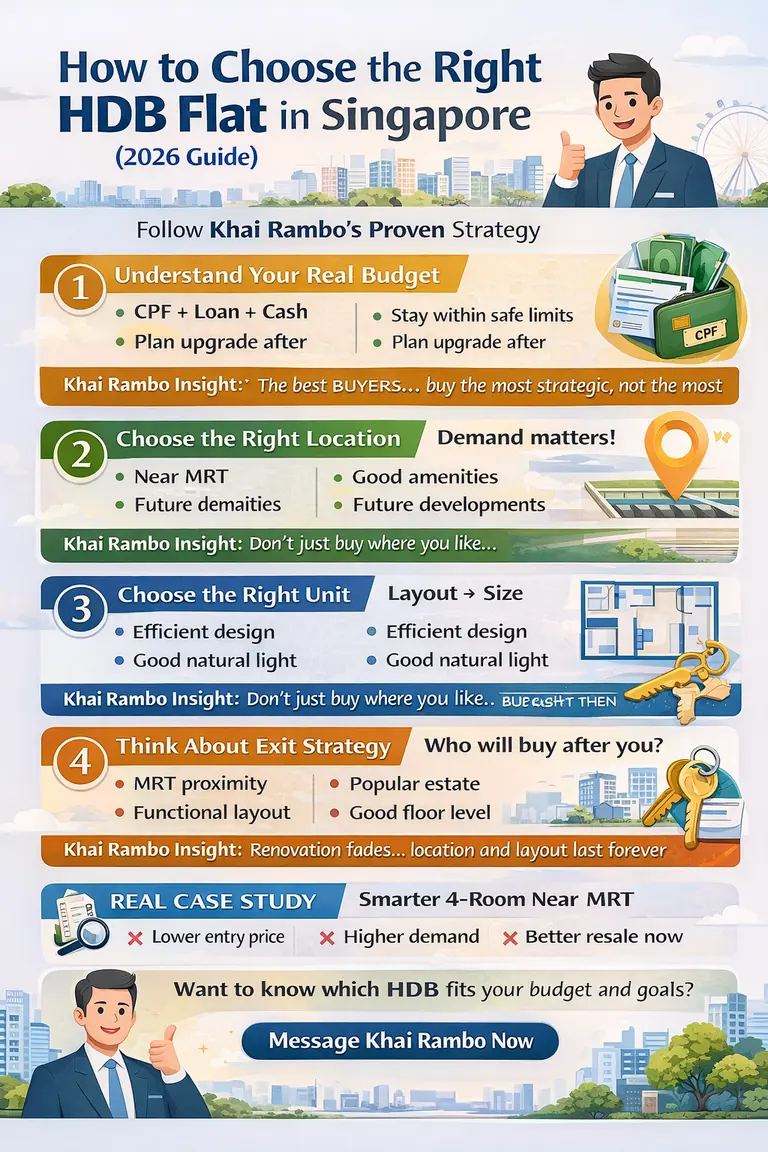
Choosing an HDB flat is easy… Choosing the right one is where most people fail.
In Singapore, many buyers buy based on emotion, follow trends blindly, or overpay for the wrong unit. And years later? They struggle to sell — or miss upgrading opportunities entirely.
Here's the truth: The profit is made when you buy right — not when you sell.
Whether you're a first-time buyer or upgrading within the HDB market, the unit you choose today determines your financial trajectory for the next 5–10 years. Get it right, and you build a launchpad for wealth. Get it wrong, and you're stuck.
In this guide, I'll walk you through a 7-step framework for choosing the right HDB flat in Singapore — covering budget, location, layout, exit strategy, and the hidden costs that catch most buyers off guard.
Step 1: Understand Your Real Budget (Not Just Your Loan Amount)
Your real HDB budget is the price you can fund while preserving monthly breathing room and cash for duties, legal fees, renovation, furnishings and emergencies, not the maximum loan shown on an approval. Start with the HFE outcome, CPF and available cash, then cap repayments at a level the household can sustain through setbacks.
Most buyers think: "If the bank approves, I can buy."
That's a dangerous assumption. Your loan approval tells you the maximum the bank will lend — not what you can safely afford. Your real budget is made up of three components that need to work together.
What Your Budget Really Includes
Illustrative assumptions: The figures below demonstrate addition only. HDB and bank loan limits depend on current policy, remaining lease, existing loans and credit assessment; use the amounts in your HFE and lender offer.
| Component | Example |
|---|---|
| CPF Ordinary Account | $100,000 |
| HDB Loan (80%) or Bank Loan (75%) | $400,000 |
| Cash (COV + legal fees + buffer) | $30,000 |
| Total Budget | $530,000 |
The Hidden Risk of Maxing Out
If you stretch to your maximum budget:
- Less financial flexibility — no buffer for emergencies, job loss, or interest rate changes
- Higher monthly stress — mortgage payments consume too much of your income
- Lower upgrade potential — you're trapped because there's nowhere to go but down
The Safe Budget Rule
As a conservative adviser planning heuristic, you may test a mortgage at 25% of combined gross income. This is not an official lending limit or a universal safe level; choose a lower figure where income, childcare, debt or other commitments require it.
Khai Rambo Insight:
The best buyers don't buy the most expensive flat they can afford. They buy the most strategic one — leaving room to upgrade later when the timing is right.
Step 2: Choose the Right Location (Future Demand Matters More Than You Think)
Choose location by prioritising durable future demand: practical MRT access, schools, daily amenities and confirmed neighbourhood improvements typically matter more at resale than cosmetic finishes. Compare recent transactions and the URA Master Plan, but do not pay any premium blindly; the location advantage must remain affordable and relevant to your planned exit.
Location is an important resale factor, but no single feature determines value. Compare price, remaining lease, flat type, floor, condition and local supply alongside access to transport and amenities.
Near MRT = Higher Demand
MRT access can broaden demand, but there is no universal 500-metre price premium or guaranteed selling speed. Compare similar records in the official HDB resale transaction dataset before paying more for proximity.
Schools, Malls & Food Centres
School and amenity access may matter to some households, but an unsourced 10–15% premium should not be assumed. Compare like-for-like transactions and confirm current school-distance rules before assigning a price to proximity.
Future Developments Are Your Edge
Check the URA Master Plan for upcoming developments in your target area:
- New MRT lines — Cross Island Line, Jurong Region Line
- Upcoming commercial hubs — Tengah, Woodlands North, Punggol Digital District
- Town transformation plans — areas earmarked for rejuvenation often see strongest price growth
Location Comparison: Impact on Resale Value
| Location Factor | Impact on Value | Exit Difficulty |
|---|---|---|
| Within 500m of MRT | Transaction-specific | Easy |
| Near top primary school (<1km) | Transaction-specific | Easy |
| Near future MRT (under construction) | Uncertain until delivered | Moderate |
| Mature estate (Toa Payoh, Bishan, etc.) | Town- and flat-specific | Easy |
| No MRT, no school, no plans | Transaction-specific | Hard |
Khai Rambo Insight:
Don't just buy where you like. Buy where the next buyer will want to live. That shift in thinking is what separates homeowners from wealth builders.
Step 3: Choose the Right Unit (Layout Beats Size Every Time)
Choose a unit for efficient usable space, natural light, ventilation and broad buyer appeal rather than room count alone. A squarish four-room layout can live and resell better than a larger flat with long corridors, awkward corners or excessive heat. Compare orientation, floor level, structural walls and functional bedroom dimensions before deciding.
Many buyers obsess over size — "I want a 5-room!" But they ignore a far more important factor: layout efficiency.
A well-designed 4-room flat with a squarish layout can feel more spacious — and perform better on resale — than a poorly-designed 5-room flat with wasted corridors and odd angles.
What to Look For in a Unit
- Squarish layout — maximises usable floor area, easier to furnish
- Minimal wasted space — avoid long corridors, pie-shaped rooms, and awkward corners
- Good natural light — north-south facing units avoid direct afternoon sun
- Functional room sizes — bedrooms that fit a queen bed + wardrobe comfortably
- Good ventilation — cross-ventilation between windows reduces reliance on aircon
What to Avoid
- Odd-shaped units with triangular or trapezoidal rooms
- Too many structural walls — limits renovation flexibility
- Units facing west — afternoon heat drives up cooling costs and buyers penalise this
- Ground-floor or low-floor units without a view — unless significantly discounted
Floor Level Matters
Higher floors generally command better prices due to views, breeze, and status perception. But mid-floor units often offer the best value — decent views at a lower price point.
Khai Rambo Insight:
A well-designed 4-room flat will outperform a poorly-designed 5-room flat — both in livability and resale. Always view the floor plan before falling in love with the unit.
Step 4: Think About Your Exit Strategy (The Most Important Step)
Plan the exit before buying by identifying who is likely to want the flat in five to eight years and what price range they can afford. MRT access, a functional layout, sensible remaining lease and established estate demand broaden the future buyer pool; expensive renovation cannot compensate for weak fundamentals.
Before you commit to any HDB flat, ask yourself one question:
"Who will buy this from me in 5–8 years?"
If you can't answer that question confidently, you shouldn't buy that unit.
Strong Exit Factors
| Factor | Why It Helps You Exit |
|---|---|
| MRT proximity | Wider pool of buyers always looking for MRT access |
| Popular estate | Mature towns like Bishan, Toa Payoh, Queenstown never lack demand |
| Good floor level | Mid-to-high floors attract more buyers and command premiums |
| Functional layout | Squarish, well-lit units are universally appealing |
Common Mistake
Buying based on "cheap price" or "nice renovation". A low price usually means low demand — and you'll struggle to sell later. And renovation is temporary — the next buyer will rip it out and redo it anyway.
Khai Rambo Insight:
Renovation fades… but location and layout stay forever. The smartest buyers choose units that future buyers will fight over.
Step 5: Understand the Hidden Costs (This Is Where Buyers Get Caught)
Budget beyond the flat's price and downpayment. HDB buyers may also need buyer's stamp duty, conveyancing fees, valuation-related costs, renovation, furniture, appliances, moving expenses and any Cash Over Valuation, which must be paid in cash. Keep these funds separate from the emergency reserve before making an offer.
The purchase price is only part of the equation. Many buyers deplete their savings on the downpayment and then scramble to cover everything else.
Full Cost Breakdown
Planning assumptions: Calculate stamp duty with the current IRAS BSD rates. Legal, renovation, furniture and appliance ranges below are illustrative only and should be replaced with actual quotes.
| Cost | Estimated Amount |
|---|---|
| Buyer Stamp Duty (BSD) | $5,400–$9,600 |
| Legal / Conveyancing Fees | $2,000–$3,000 |
| Renovation (Resale) | $30,000–$80,000 |
| Renovation (BTO) | $20,000–$50,000 |
| Furniture & Appliances | $5,000–$15,000 |
| COV (Cash Over Valuation) | Varies (cash only) |
The Renovation Trap
It's tempting to design your dream home, but a buyer planning to sell in five to eight years should not assume a future purchaser will reimburse an expensive kitchen. Keep renovation spending proportionate to the holding plan and local transaction evidence.
Khai Rambo Insight:
Smart buyers plan beyond the purchase. They budget for the lifestyle after buying — not just the moment of buying. If you spend everything to get the keys, you've already started on the back foot.
Illustrative Case Study: Testing Size Against Affordability
This illustrative composite compares a S$510,000 four-room Punggol flat with a hypothetical S$620,000 five-room Sengkang option. Under the stated assumptions, the smaller home reduces the entry price by S$110,000 and lowers repayment stress. The figures demonstrate a decision method; they are not a documented client transaction or forecast.
Illustrative assumptions: A fictional couple compares a five-room Sengkang HDB at S$620,000 with a smaller alternative while planning for a family.
The problem:
- The unit was 800m from the nearest MRT — too far for strong resale demand
- Their budget would be fully stretched — mortgage at 35% of income
- The layout had a long corridor wasting 15% of the floor area
- Remaining lease was 72 years — requiring a specific financing, CPF and resale comparison rather than an automatic value-decay conclusion
What we did instead:
- Identified a 4-room flat in Punggol — 3 minutes walk to MRT, near Waterway Point and a popular primary school
- Purchase price: $510,000 — saving them $110,000 in entry cost
- Squarish layout with less corridor space under the scenario's floor-plan comparison
- Monthly mortgage: 22% of income — comfortable with buffer for baby expenses
Result:
- Comfortable living space for a growing family
- Strong MRT proximity for future resale
- $110,000 saved for renovation, savings, and future upgrade
- Retains more buffer to reassess an upgrade after the applicable MOP
The lesson: Buying bigger is not always smarter. Buying better is.
7 Mistakes HDB Buyers Must Avoid
The seven mistakes to avoid are buying emotionally, searching before confirming the HFE budget, sacrificing location for size, overpaying Cash Over Valuation, ignoring layout, over-renovating and purchasing without an exit plan. Each can erode affordability or resale value, so assess the numbers and fundamentals before becoming attached to any unit.
- Buying based on emotion — falling in love with a unit before checking the numbers
- Ignoring HFE / budget limits — house-hunting without knowing your true affordability
- Choosing a poor location — prioritising size or price over MRT access and demand
- Overpaying COV — paying excessive Cash Over Valuation because you're emotionally attached
- Ignoring layout — not reviewing the floor plan and ending up with wasted corridors
- Over-renovating — spending $80,000 on a flat you'll sell in 5 years
- No exit strategy — buying without thinking about who will buy it from you later
Khai Rambo Insight:
Avoid even one of these mistakes and you're already ahead of most buyers. Avoid all seven, and you're set up to build real wealth through property.
Your 7-Step Framework to Choose the Right HDB
Use a seven-step HDB selection process: secure the HFE letter, set a sustainable all-in budget, choose demand-supported locations, compare several units, inspect layouts and orientation, check recent resale evidence, then negotiate and coordinate the purchase carefully. Keeping these steps in order reduces emotional decisions and exposes trade-offs before commitment.
Follow this proven framework and you won't go wrong:
- Get your HFE letter — know your exact loan, CPF, and grant eligibility before anything else
- Set your real budget — choose a conservative repayment comfort level, with a separate cash buffer for costs
- Identify target locations — prioritise MRT, schools, and future developments
- Shortlist units — compare 3–5 units based on location, floor level, and layout
- Evaluate layout — review floor plans, visit units, check orientation and ventilation
- Check resale demand — look at recent transaction prices and how quickly similar units sell
- Secure your unit — with guidance from a trusted property advisor who knows the market
Follow this framework = lower risk + better upside. Skip steps = regrets later.
Final Thoughts
The right HDB flat balances five fundamentals: sustainable affordability, a location with durable demand, an efficient layout, manageable total costs and a credible future exit. No single renovation, view or extra room should override that combination. Verify the facts, retain a cash buffer and choose the home that supports both today's life and tomorrow's options.
Choosing the right HDB flat is not about luck — it's about strategy.
If you focus on these five pillars:
- Real budget (not maximum loan)
- Strategic location (future demand, not just current preference)
- Efficient layout (not just size)
- Strong exit strategy (who buys it from you?)
- Full cost planning (beyond the purchase price)
You won't just buy a home — you'll make a smart financial move that positions you for wealth building in the years ahead.
Frequently Asked Questions
What should I check first when choosing an HDB flat?
Check your current HFE outcome and comfortable all-in budget first. Then define non-negotiable household needs such as location, commute, bedrooms and move-in timing. This prevents attractive renovation or an urgent sales pitch from pulling you toward a flat that is unaffordable, unsuitable or difficult to exit when your circumstances change.
Which HDB flat features support future resale demand?
Features that many future buyers value include practical layouts, usable bedrooms, convenient transport, everyday amenities and a sufficient remaining lease, but demand differs by town and price segment. Compare actual transactions and competing supply. Do not overpay for a high floor, view or renovation unless buyers in that specific market consistently recognise the premium.
How important is the remaining HDB lease?
The remaining lease matters because it can affect financing, CPF usage, buyer eligibility and future resale demand. Its importance depends on your age, holding period and price paid. Check the exact lease commencement and current rules, then compare the flat with alternatives rather than assuming every older unit is poor value.
Which official sources should you verify?
Property rules, financing limits, duties and market figures can change after publication. Before acting, verify the claim that affects your decision with the responsible Singapore institution below. The article’s comparisons and professional observations are general guidance; your current eligibility, loan assessment, tax position and transaction documents remain decisive.
- Housing & Development Board (HDB) property guidance
- Central Provident Fund Board (CPF) property guidance
- MoneySense Singapore property guidance
- Inland Revenue Authority of Singapore (IRAS) property guidance
Source review: Primary-source links checked 17 July 2026. See the property editorial and correction policy for the evidence standard.
Not Sure Which HDB Flat Is Right for You?
Get a personalised analysis of your budget, location options, and best units — at no cost.
WhatsApp Khai Rambo Get Free Valuation