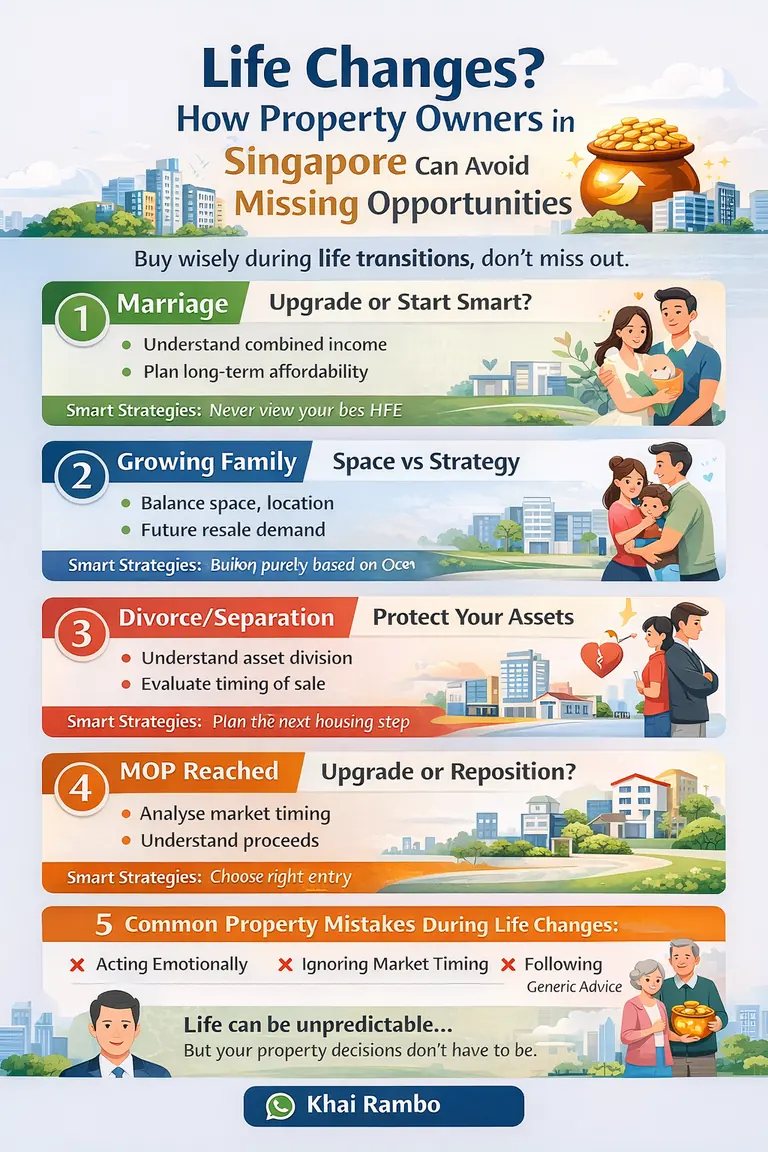
Most property mistakes don't happen because people are careless… They happen because people are going through life changes.
Marriage. Divorce. Children. Upgrading. Downsizing. Financial pressure.
These moments feel deeply personal — but they are also financial turning points. And the decision you make during these transitions can either build your wealth… or set you back for years.
In Singapore's high-stakes property market, a rushed move during a life transition can reduce equity, cause overpayment or limit future options. The impact is transaction-specific; there is no defensible universal S$50,000-to-S$200,000 loss range.
In this guide, I'll show you how property owners in Singapore can navigate 5 major life transitions strategically — and avoid the costly mistakes that most people make.
Why Life Transitions Are Critical Property Moments
Life transitions are critical property moments because marriage, children, separation, MOP completion or retirement can change space needs, ownership eligibility, cash flow and time horizon at once. Reviewing the property plan early creates more options; acting only after urgency peaks can force a rushed sale, overstretched purchase or poorly timed move.
Life transitions are a common reason to review property plans. When something big changes, many owners ask: "Should I move? Should I sell? Should I upgrade?"
The 5 Transitions That Trigger Property Decisions
| Life Transition | Common Property Action | Risk If Done Wrong |
|---|---|---|
| Getting Married | Buy first home or upgrade | Overstretching budget |
| Growing Family | Upgrade for more space | Buying wrong location |
| Divorce / Separation | Forced sale or asset split | Selling at a loss |
| MOP Reached | Sell HDB, upgrade to condo | Bad timing, overpaying |
| Retirement / Downsizing | Sell large property, downsize | Losing long-term value |
The Real Problem
Most property owners during life transitions:
- Act based on emotion — rushing because it "feels right"
- Rush major decisions — selling or buying within weeks instead of planning
- Follow generic advice — listening to friends and family instead of analysing the numbers
Khai Rambo Insight:
Life changes are emotional — that's natural. But property decisions must remain strategic. The owners who separate emotion from execution are the ones who come out ahead.
Transition 1: Marriage — Upgrade or Start Smart?
Marriage is the moment to build a shared housing plan, not automatically buy the largest home a loan allows. Couples should test affordability against one-income scenarios, preserve an emergency fund and favour location over unnecessary size. A strategically chosen first home can meet near-term needs while building equity and flexibility for a later upgrade.
When couples get married, the first big question is usually: "Should we buy a bigger home?"
The excitement of starting a new chapter together often leads to a dangerous trap: buying more than you need, earlier than you should.
Common Mistake
Newly married couples commonly jump straight into:
- A larger property than they need (e.g., 5-room HDB when a 4-room is sufficient)
- A higher loan that stretches their monthly budget to the limit
- Higher financial stress that limits their flexibility for the next 5–10 years
The Smart Strategy
- Understand your combined income and CPF — calculate what you can safely afford, not the maximum the bank will lend
- Plan for long-term affordability — can you still pay comfortably if one partner stops working?
- Think about your next upgrade — your first home should build equity for your second property
- Choose location over size — a well-located 4-room flat will outperform a poorly-located 5-room in resale value
Budget Framework for Newlyweds
Planning heuristic: The percentages and time horizons below are conservative adviser assumptions, not official affordability rules or guarantees. Adjust them for income stability, dependants, debt and the household's actual goals.
| Guideline | Recommendation |
|---|---|
| Monthly mortgage | Max 25% of combined gross income |
| Emergency fund | 6 months of expenses after purchase |
| Renovation budget | Set aside separately — never use loan funds |
| Upgrade timeline | Plan your exit within 5–8 years |
Khai Rambo Insight:
Your first home as a couple should not be your final home… It should be your stepping stone. Buy smart now, and you'll have the equity to upgrade to your dream home later.
Transition 2: Growing Family — Space vs Strategy
A growing family needs enough functional space, but urgency should not override affordability or future demand. Choose a home that works for the next five to eight years, near practical transport, schools and amenities, with a layout future buyers will value. The best upgrade balances family comfort, cash reserves and resale potential.
When children arrive, everything changes. The two-bedroom flat suddenly feels cramped. You start thinking about better schools, bigger rooms, and more storage.
The instinct is natural — but the way most parents act on it is financially dangerous.
What Most Parents Do (Wrong)
- Buy the biggest property they can find
- Choose based on emotion and urgency ("The baby is coming!")
- Ignore the resale potential of the new property
The Strategic Approach
Instead of buying purely for size, balance three critical factors:
- Space — enough for your family's needs for the next 5–8 years, not forever
- Location — near practical schools, MRT and amenities, while comparing like-for-like transactions instead of assuming a standard school premium.
- Future resale demand — will someone want to buy this from you when your kids are older and you're ready to move again?
School Proximity Impact on Property Value
School proximity may affect family demand, but it does not automatically pay for itself. Compare similar records in the official HDB resale transaction dataset and verify current school-distance rules before paying a premium.
Khai Rambo Insight:
A bigger home is not always a better investment. A well-positioned home is. Buy for your family's needs and your financial future — not just one or the other.
Transition 3: Divorce or Separation — Protect Your Assets
During divorce or separation, protect value by slowing the property decision down enough to establish ownership rights, a proper valuation, sale or buyout options and each person's next housing plan. Emotional urgency can produce a discounted sale or unaffordable replacement, so coordinate legal advice, financing and timing before agreeing to dispose of the asset.
This is one of the most sensitive and emotionally charged property situations. During a divorce, property decisions are often made in haste — driven by anger, pain, or a desire to "just get it over with".
That urgency can create a discounted sale or an unaffordable replacement, but the financial impact depends on the actual valuation, legal outcome and timing.
Key Risks
- Forced sale at bad timing — selling when the market is soft because you need to divide assets quickly
- Financial loss from rush decisions — accepting a low offer just to close the chapter
- Emotional decision-making — letting feelings dictate financial outcomes
Smart Moves During Divorce
- Understand your asset division options — does one party buy out the other? Do you sell and split proceeds? Each option has different financial implications.
- Evaluate the timing of sale — if the market is in your favour, selling sooner may be better. If not, consider whether one party can hold the property temporarily.
- Plan your next housing step — where will you live after? Renting temporarily might give you time to find a better deal.
- Get a proper valuation — know what your property is truly worth before agreeing to any division. A free valuation is a good starting point.
Khai Rambo Insight:
In difficult situations, clarity is your biggest advantage. Don't let emotional pressure force you into a bad property decision. Take your time, understand the numbers, and protect your financial future.
Transition 4: MOP Reached — Upgrade or Reposition?
Reaching MOP is a review point, not a signal to upgrade immediately. First calculate true HDB sale proceeds, borrowing capacity, duties and post-purchase reserves; then compare holding, selling and upgrading against current market conditions. Move only when the next property improves long-term position and the household can absorb transition costs comfortably.
After meeting the applicable HDB MOP and resale conditions, many owners review whether to upgrade. The exact occupation period depends on the flat and scheme, so do not assume every home follows the same five-year rule.
But rushing to upgrade is one of the most common — and costly — mistakes in Singapore property.
The Mistake
- Selling without a plan — listing your HDB without knowing what you'll buy next or when
- Buying at peak prices — upgrading to a condo just because "everyone else is doing it"
- Ignoring the numbers — not calculating net proceeds, ABSD, BSD, and true affordability
The Strategic Approach
- Analyse market timing — is this a seller's market or buyer's market?
- Calculate your true proceeds — selling price minus outstanding loan minus CPF refund minus agent fees
- Choose the right entry point — define evidence-based criteria, recognising that waiting can improve or worsen the eventual price
For a detailed breakdown of all 4 MOP upgrade strategies, read our guide: HDB MOP Reached? How to Earn Your Second Pot of Gold.
Khai Rambo Insight:
Do not upgrade simply because you can. Start early enough to verify the numbers and timelines, without treating a six-to-twelve-month window as a universal rule.
Transition 5: Downsizing — Unlock Cash or Miss the Opportunity?
Downsizing can release substantial retirement capital while reducing upkeep, but success depends on what you buy next and how sale proceeds are used. Time the sale carefully, choose an accessible home near transport, healthcare and daily amenities, and calculate net cash after purchase costs so comfort and financial resilience both improve.
For older homeowners, downsizing is an increasingly common strategy. The kids have moved out, the big house feels empty, and there's a strong desire to free up cash for retirement.
Downsizing done right can be transformative. Done wrong, it can erode the very wealth you've spent decades building.
Common Mistakes
- Selling without a strategy — accepting the first offer without testing the market
- Downsizing to the wrong property — moving somewhere that depreciates faster than your old home
- Not optimising cash flow — failing to invest or deploy the sale proceeds wisely
Smart Downsizing Approach
- Choose the right timing — sell when demand for your property type is strong
- Optimise cash flow — structure the sale and purchase to maximise the cash you free up
- Plan your next move carefully — consider a well-located 2-bedroom condo or a resale HDB in a mature estate
- Factor in retirement needs — proximity to hospitals, MRT, and daily amenities becomes more important than ever
Downsizing Comparison: What You Could Free Up
Illustrative arithmetic: The table uses round hypothetical prices and excludes loan redemption, CPF refunds, duties, fees, renovation and moving costs. It is not a current market valuation; replace every figure with verified transactions and transaction-specific statements.
| Scenario | Sell Price | Buy Price | Cash Freed |
|---|---|---|---|
| Condo → Resale HDB | $1,500,000 | $550,000 | ~$950,000 |
| 5-room HDB → 3-room HDB | $680,000 | $350,000 | ~$330,000 |
| Landed → 2-bed Condo | $3,000,000 | $1,200,000 | ~$1,800,000 |
Khai Rambo Insight:
Downsizing is not about reducing… It's about repositioning your wealth. Done strategically, it can fund your retirement, support your children, and still keep you in a comfortable home.
7 Common Mistakes Property Owners Make During Life Transitions
The seven recurring errors are acting emotionally, rushing, ignoring market timing, overstretching the mortgage, prioritising cosmetic features over location, buying without an exit plan and following generic advice. Avoid them by documenting needs, financial limits and timing first, then testing every option against verified market evidence and the household's next life stage.
- Acting emotionally — letting feelings drive a six-figure financial decision
- Rushing major decisions — selling or buying within weeks instead of planning over months
- Ignoring market timing — buying at peak because "I need to move now"
- Overstretching finances — taking on a mortgage that leaves zero buffer for unexpected expenses
- Choosing the wrong location — prioritising cosmetic features over fundamentals like MRT, schools, and future demand
- Not planning an exit strategy — buying without thinking about who will buy it from you in 5–10 years
- Following generic advice — listening to friends and social media instead of getting professional analysis based on your specific situation
Khai Rambo Insight:
Every transition deserves a deliberate review. Planning ahead can expose avoidable risks, but no strategy guarantees a profitable outcome.
Illustrative Case Study: A Growing Family's Housing Trade-off
This illustrative composite compares a Bishan five-room target with a hypothetical S$580,000 four-room Toa Payoh flat. Under the assumptions, repayments stay below 28% of income and S$20,000 remains for renovation and emergencies. The figures demonstrate affordability trade-offs; they are not a documented client result, current valuation or resale forecast.
Illustrative assumptions: A fictional couple expecting a second child lives in a three-room Bishan HDB and is considering an immediate move to a five-room or executive flat.
Their initial plan: sell the 3-room and buy the biggest flat they could find in the same area.
The problem:
- The scenario assumes five-room Bishan resale options at S$750,000–S$850,000, which would stretch the stated budget
- Their monthly mortgage would have consumed 40% of income
- They would have no buffer for renovation, childcare, or emergencies
What we did instead:
- Set the scenario's conservative budget at S$620,000, rather than S$800,000
- Assumed comparable four-room Toa Payoh options at S$550,000–S$600,000; real candidates must be checked against current HDB transactions
- Shortlisted 3 units in a well-located block near Toa Payoh MRT and a reputable primary school
- Modelled a S$580,000 purchase with monthly payments under 28% of income
Result:
- Enough space for the growing family
- Potentially broader demand from transport and school access, without a guaranteed resale premium
- $20,000 buffer remaining for renovation and emergencies
- Well-positioned for a condo upgrade in 5–7 years
The lesson: Life changes don't force bad decisions… Lack of strategy does.
Your Step-by-Step Framework for Property Decisions During Life Transitions
Use a six-step process for any life transition: define the changed housing need, review finances, set five-to-ten-year goals, assess current market conditions, choose whether to hold, sell, upgrade or reposition, then coordinate execution. Completing the steps in order separates a genuine housing requirement from emotional urgency and exposes risks before money is committed.
No matter what transition you're going through, follow this 6-step framework:
- Identify your life stage — what transition are you in? Marriage, family growth, MOP, divorce, retirement?
- Review your financial position — CPF balances, loan eligibility, existing commitments, emergency funds
- Define your long-term goals — where do you want to be in 5–10 years? What does your ideal outcome look like?
- Analyse market conditions — is it a good time to sell? To buy? Or to wait?
- Choose your strategy — hold, sell, upgrade, or reposition based on data, not emotion
- Execute with professional guidance — timing, negotiation, financial structuring, and legal coordination all matter
This is where most people go wrong. They skip steps 2–4 and jump straight from "I need to move" to "I'm buying this". The owners who follow the framework consistently make better decisions — and more money.
Final Thoughts
A life change can become a property opportunity only when the decision protects both immediate wellbeing and long-term finances. Start early, clarify the new need, verify affordability and market evidence, preserve reserves and plan the next exit. Strategy cannot remove uncertainty, but it can prevent urgency from turning a difficult transition into a lasting financial mistake.
Life transitions are unavoidable. But missed opportunities are not.
If you approach property decisions during life changes with clarity, strategy, and professional guidance, you won't just protect your assets — you'll grow them.
Whether you're getting married, growing your family, navigating a divorce, reaching MOP, or planning for retirement — every transition is a chance to reposition, restructure, and build wealth.
The only question is: will you seize it?
Frequently Asked Questions
When should a life change trigger a property review?
Review your property plan when household ownership, income, space needs or expected location changes materially. Marriage, a new child, separation, retirement, MOP completion and caring responsibilities are common triggers. Start early enough to check legal, housing and financing implications before deadlines or emotional pressure reduce the options available to the household.
Should I upgrade property when my family grows?
Upgrade only when the additional space solves a durable need and the complete move remains affordable. Compare reconfiguring the current home, moving to another HDB, EC or private property, and waiting. Include childcare, education, transport and income changes in the budget, because a larger home should not undermine the family's wider financial resilience.
How can owners avoid a rushed property sale?
Begin with a written timeline, realistic valuation and complete list of ownership or family constraints. Prepare documents, calculate loan and CPF positions, and identify temporary housing before committing to the next property. Where separation, inheritance or legal rights are involved, obtain appropriate professional advice so the sale sequence reflects binding obligations rather than assumptions.
Which official sources should you verify?
Property rules, financing limits, duties and market figures can change after publication. Before acting, verify the claim that affects your decision with the responsible Singapore institution below. The article’s comparisons and professional observations are general guidance; your current eligibility, loan assessment, tax position and transaction documents remain decisive.
- MoneySense Singapore property guidance
- Inland Revenue Authority of Singapore (IRAS) property guidance
- Urban Redevelopment Authority (URA) property guidance
- Council for Estate Agencies (CEA) property guidance
Source review: Primary-source links checked 17 July 2026. See the property editorial and correction policy for the evidence standard.
Going Through a Life Transition?
Get a personalised property strategy tailored to your situation, finances, and goals — at no cost.
WhatsApp Khai Rambo Get Free Valuation